Showing posts with label Mountains. Show all posts

Maps From Books: A Review of a New Book


Well, someone has beat me to it, but maybe that didn't get everything? From the linked Weekly Standard review:

"Barring some unforeseen miracle of publishing occurring in the next few weeks, The Writer’s Map will be my book of the year for 2018. It gathers intelligently charming meditations from writers and festoons them with map after map after map after map of imaginary, and sometimes non-imaginary, lands. (Only after several days of staring at the beautifully reproduced images did I force myself to read the words, but I am glad I finally did.) I am so enamored of this book that I bitterly resent what takes me away from it, whether that be the need to eat, or sleep, or write this review. But when duty calls, I sometimes answer."


Read the full review here:


https://www.weeklystandard.com/alan-jacobs/the-writers-map-review-cartographantasies

For my collection of maps from books click here.

"With the help of the California Motor Company and Goodman publishing, Wyman was finalizing preparations for his epic motor-cycle ride across America.  It is likely this two sentence news clipping was the first public notice of Wyman's attempt.  It would be the beginning of publicity designed to launch The Goodman Company's new periodical, "The Motorcycle Magazine."

"Across America on a Janus Motorcycle"
"We are pleased to announce Janus Motorcycles  will join the 2018 - Wyman Memorial Challenge, 'Rendezvous.'  115 years after Wyman's historic 1903 journey, on single cylinder, 200cc motorcycle, Janus Motorcycles is paying tribute to the Wyman legacy by duplicating this challenging ride on their top-of-the-line Halcyon 250.  Janus and riders from around the country will 'Rendezvous' in the San Francisco Bay Area on Memorial Day weekend.  The Grand Tour begins Monday, May 28 and runs through Saturday, June 2, 2018.

"Richard Worsham, co-founder of the company will be riding the Janus Halcyon 250 from San Francisco to New York City.  The Janus Halcyon, single cylinder, 229cc, 14 horse power, 5-speed motorcycle is built in Goshen, Indiana.  Janus Motorcycles is the hosting authority for the 624.3 Goshen Wyman waypoint.

"Since the California Gold Rush days, the distance between San Francisco and New York City set the standard for cross continent travel.  The completion of the transcontinental railway shortened a grueling eight week wagon journey to a relatively comfortable 83 hour express train ride. 

Iron Butt Magazine, Spring 2013
"Wyman's 50 day motorized journey from San Francisco to New York City represented the next step in the technology of personal transcontinental travel.  Today, on modern motorcycles, members of the Iron Butt Association pay tribute to Wyman's legacy, making the San Francisco to New York City ride in under 50 hours." 


George A. Wyman...
"World's Toughest Motorcycle Rider, circa 1903"

Principe

Found these in WallMart the other day. Principes were instrumental in my completing the Camino de Santiago in 2005. I have fond memories of them, and yes, they are still very good.

La Madonna di San Luca

 
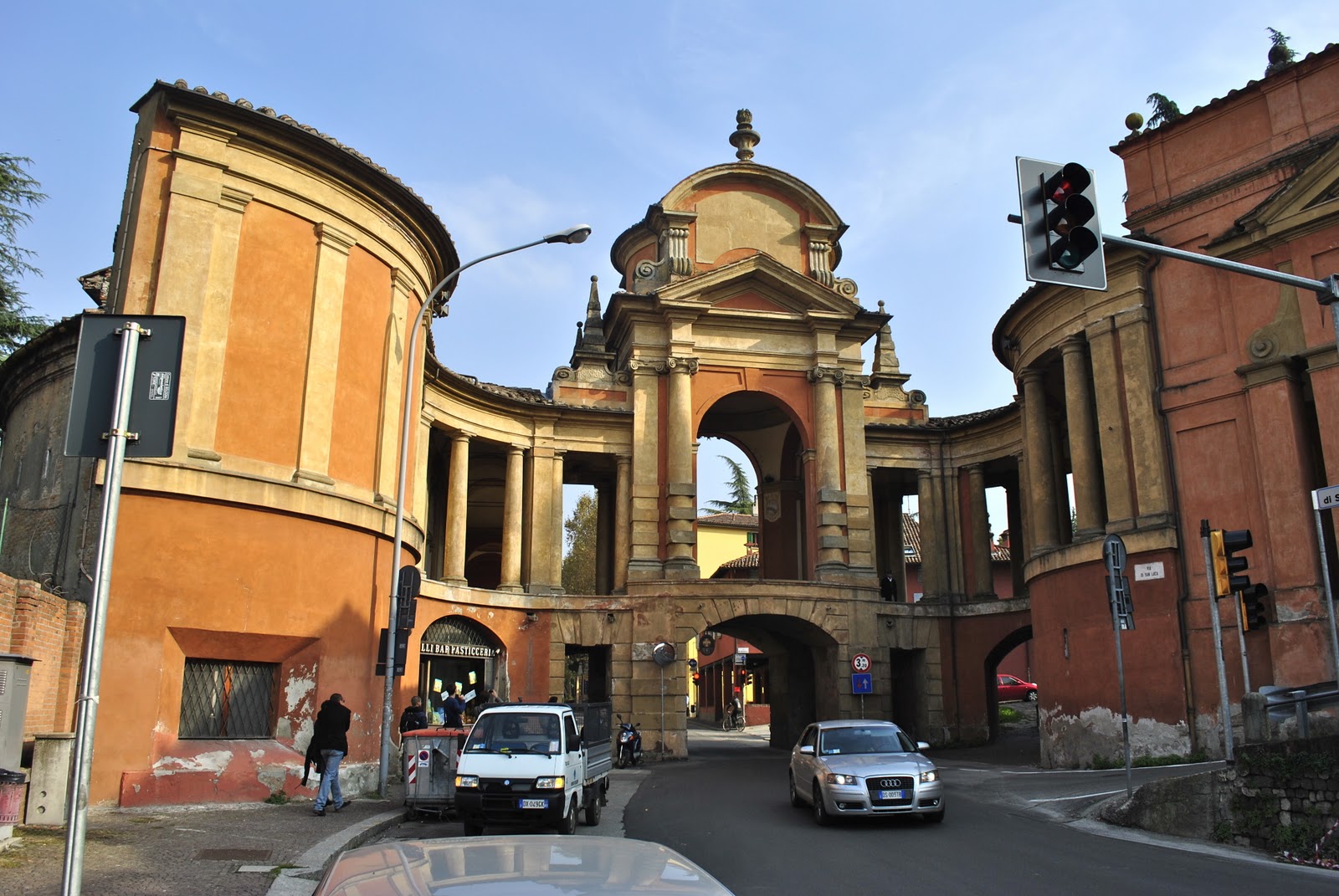
The Madonna di San Luca sits outside the city of Bologna on Monte della Guardia. The church houses an image of the Madonna and Child attributed to St. Luke with miraculous powers which have made it a significant pilgrimage site. The church is joined to the city by an arcade composed of 666 arches stretching from the city gate out of the city, over the road and up the mountain. The arcade provides shelter for pilgrims and protection for the relic on its annual procession down into Bologna. The reasoning behind the peculiar number of arches is said to be an attempt protect the relic on its journey by beating the Devil at his own game. The arcade, gate and church were all designed by Carlo Francesco Dotti and built between 1674 and 1793. Sections of the arcade between the city gate and the pilgrim bridge now support five story buildings along what one hundred years ago would have been farmland, and since the builders seemed to have been more concerned with quantity than quality some of the arches list at disturbing angles. The walk to the top is quite a hike especially since each arch is numbered, reminding you how few arches you have passed.
 The beginning of the Portico di San Luca leading out of the city
The gate of the city facing the arcade

 The arcade stretching out to the fantastic gate and bridge over the road
 The gate from the inside
 View of the gate from the countryside. The pilgrim route climbs up a set of stairs, over the road and around the curve of the left wing of the gate and then up the mountain
The arcade stretching up the steep mountain
 Looking back down the arcade
 
The central portico of the church
The altar
The Madonna of St. Luke
An aerial view of the church and arcade
A great gypsy manouche band (Tolga During) performing  in Piazza Maggiore in front of the cathedral

Red Bull Alpenbrevet!?

 Yes, there have been a lot of moped posts lately, but I can't not post this: The Red Bull Alpenbrevet, a race through the Swiss Alps on mopeds... No, this is not a joke. The Team America Blog.

Objects

Meridians are a net
Which catches nothing; that sea-scampering bird
The gull, though shores lapse every side from sight, can yet
Sense him to land, but Hanno had not heard

Hesperidean song,
Had he not gone by watchful periploi:
Chalk rocks, and isles like beasts, and mountain stains along
The water-hem, calmed him at last near-by

The clear high hidden chant
Blown from the spellbound coast, where under drifts
Of sunlight, under plated leaves, they guard the plant
By praising it. Among the wedding gifts

Of Herë, were a set
Of golden McIntoshes, from the Greek
Imagination. Guard and gild what’s common, and forget
Uses and prices and names; have objects speak.

There’s classic and there’s quaint,
And then there is that devout intransitive eye
Of Pieter de Hooch: see feinting from his plot of paint
The trench of light on boards, the much-mended dry

Courtyard wall of brick
And sun submerged in beer, and streaming in glasses,
The weave of a sleeve, the careful and undulant tile. A quick
Change of the eye and all this calmly passes

Into a day, into magic.
Is there any end to true textures, to true
Integuments; do they ever desist from tacit, tragic
Fading away? Oh maculate, cracked, askew,

Gay-pocked and potsherd world
I voyage, where in every tangible tree
I see afloat among the leaves, all calm and curled,
The Cheshire smile which sets me fearfully free.

-Wilbur 

Maps from Books VI

The Mysterious Island
by Jules Verne

“Lincoln Island” as engraved by Sédille for Hetzel,
based on a sketch by Verne. Mysterious Island (1875). 
Image from Science Fiction Studies

Camogli & San Fruttuoso

The fishing village of Camogli
The harbour
The active fishing fleet
Mending nets
The only way of reaching San Fruttuoso
San Fruttuoso
The Abbey and Church

The whole inlet is thick with the sound of cicadas in the olive trees above the Abbey

The church beneath which the Pamphilij are buried
Fishing nets and anchors under the Abbey


The Cloister

The Doria Pamphilij Tower

San Fruttuoso
When one speaks of San Fruttuoso with someone who knows this splendid locality on the promontory of Portofino, few are aware that the complete name of the nuclear abbey of this little village is San Fruttuoso di Capodimonte. Capodimonte explains the name; San Fruttuoso explains the legend which we will briefly relate.

Arriving from Spain, the priests Giustino and Procopio of Terragona wanted to reach the coast of Liguria and bring the bones of San Fruttuoso, the archbishop of Braga and founder of monasteries in Spain and Portugal. He would later be mart yered in 262.

A strong tempest surprised them in the area of Portofino and it was here that an angel of the Lord appeared to Giustino and promised to bring him to safety in a narrow’avine in the cliffs and from which he would chase away a pestiferous dragon. The priests would then have to construct a church there among the rocks by a gushing spring.
It was thus that the locality where the church was constructed and later the monastery, first of thefollowers of Saint Colombano and then of the Benedictines, came to be called San Fruttuoso. Here the Abbey that was to have such great importance for the Tigullian Gulf until the twelfth century developed.

The Abbey exercised rights over hunting and fishing on the entire promontory and in addition fostered agriculture, mostly on the eastern slope of the promontory of Portofino which was more suitable for cultivation.

The submission of many coastal and inland parishes reaching as far as the dio- ceses of Tortona, Bobbio, and Brugnato, were the consequences of many donations. Anticipating the fatal year 1000 that was supposed to represent the end of the uorld, many feudal lords and even emperors deprived themselves of land to be given to the church.

In particular the empress Adelaide or Adalgisa of Bourgogne must be remembered for having donated the land of the “oltregiogo” for her spiritual salvation and that of the emperor Otto I and in appreciation for the physical salvation of her son Otto II’s escape from a grave danger. Even the island of Sestri Levante belonged to the Abbey and so we can confidently talk about its supremacy over the lands of Tigullio.

Since San Fruttuoso belonged to the “marca januensis“ constituted by Berengario II in 950 and entrusted to the Obertenghi family, the relationship between the Abbey and the aristocracy was such that the existence of numerous feudal landlords such as the Fieschi, the Este and the Malaspina did not pose a serious danger to the Abbey. The Fieschi were established in eastern Tigullio while the other two were dominant in the Appenine mountains and in the Po valley and plain.

The year 1133 is a very important date in the history not only of the Genoese church but for the abbey at San Fruttuoso as well. Since Pope Innocent Il separated the diocese of Genoa from the seat of Milan, establishing it as an archdiocese with Siro II, it became necessary to reorganize the territory. The monasteries no longer had the certainty of being able to protect the borders of their property from the incroachments of lay forces and even other organs of the diocese and thus be- gan to look to Genoa for support. Genoa, looking to expand in the riviera levante, was interested in cultivating good relations with the abbey and thus eager to protect its interests on the promontory of Portofino.

In 1162 Pope Alexander III, in order that he might enjoy the support of the still wealthy and powerful Abbot of San Fruttuoso, reconfirmed the privileges of the abbey over the territories subjected to it. It was the time when he was fighting with Federico Barbarossa who had opposed him with the anti-pope Victor V.

Taken from Portofino World

Departing from Camogli train station

Monte Fasce

The climb began at the ancient fishing village of Boccaddassa (with Monte Fasce in the background).

A Vespa Si moped.


What looked like a sheep shelter near the summit.


The view of Genoa from the side of Monte Fasce.


Don't where Vans Classics while mountain climbing... or take on entire thorn bushes.


At the top.

Iron Crosses and cellphone towers.


A Napoleonic Fortress


A stump covered in the tacks of the pious in the cloister of the Franciscan Monestary on Monte Fasce.

The way down.


Back into Genoa.