Showing posts with label Edward Lear. Show all posts

The Dong and the Lady of Shalott

The Lady of Shalott
Alfred, Lord Tennyson


 Part I.


On either side the river lie
Long fields of barley and of rye,
That clothe the wold and meet the sky;
And thro' the field the road runs by
      To many-tower'd Camelot;
And up and down the people go,
Gazing where the lilies blow
Round an island there below,
      The island of Shalott.

Willows whiten, aspens quiver,
Little breezes dusk and shiver
Thro' the wave that runs for ever
By the island in the river
      Flowing down to Camelot.
Four gray walls, and four gray towers,
Overlook a space of flowers,
And the silent isle imbowers
      The Lady of Shalott.

By the margin, willow-veil'd
Slide the heavy barges trail'd
By slow horses; and unhail'd
The shallop flitteth silken-sail'd
      Skimming down to Camelot:
But who hath seen her wave her hand?
Or at the casement seen her stand?
Or is she known in all the land,
      The Lady of Shalott?

Only reapers, reaping early
In among the bearded barley,
Hear a song that echoes cheerly
From the river winding clearly,
      Down to tower'd Camelot:
And by the moon the reaper weary,
Piling sheaves in uplands airy,
Listening, whispers "'Tis the fairy
      Lady of Shalott."


         Part II.

There she weaves by night and day
A magic web with colours gay.
She has heard a whisper say,
A curse is on her if she stay
      To look down to Camelot.
She knows not what the curse may be,
And so she weaveth steadily,
And little other care hath she,
      The Lady of Shalott.

And moving thro' a mirror clear
That hangs before her all the year,
Shadows of the world appear.
There she sees the highway near
      Winding down to Camelot:
There the river eddy whirls,
And there the surly village-churls,
And the red cloaks of market girls,
      Pass onward from Shalott.

Sometimes a troop of damsels glad,
An abbot on an ambling pad,
Sometimes a curly shepherd-lad,
Or long-hair'd page in crimson clad,
      Goes by to tower'd Camelot;
And sometimes thro' the mirror blue
The knights come riding two and two:
She hath no loyal knight and true,
      The Lady of Shalott.

But in her web she still delights
To weave the mirror's magic sights,
For often thro' the silent nights
A funeral, with plumes and lights
      And music, went to Camelot:
Or when the moon was overhead,
Came two young lovers lately wed;
"I am half-sick of shadows," said
      The Lady of Shalott.


         Part III.

A bow-shot from her bower-eaves,
He rode between the barley-sheaves,
The sun came dazzling thro' the leaves,
And flamed upon the brazen greaves
      Of bold Sir Lancelot.
A redcross knight for ever kneel'd
To a lady in his shield,
That sparkled on the yellow field,
      Beside remote Shalott.

The gemmy bridle glitter'd free,
Like to some branch of stars we see
Hung in the golden Galaxy.
The bridle-bells rang merrily
      As he rode down to Camelot:
And from his blazon'd baldric slung
A mighty silver bugle hung,
And as he rode his armour rung,
      Beside remote Shalott.

All in the blue unclouded weather
Thick-jewell'd shone the saddle-leather,
The helmet and the helmet-feather
Burn'd like one burning flame together,
      As he rode down to Camelot.
As often thro' the purple night,
Below the starry clusters bright,
Some bearded meteor, trailing light,
      Moves over still Shalott.

His broad clear brow in sunlight glow'd;
On burnish'd hooves his war-horse trode;
From underneath his helmet flow'd
His coal-black curls as on he rode,
      As he rode down to Camelot.
From the bank and from the river
He flash'd into the crystal mirror,
"Tirra lirra," by the river
      Sang Sir Lancelot.

She left the web, she left the loom,
She made three paces thro' the room,
She saw the water-lily bloom,
She saw the helmet and the plume,
      She look'd down to Camelot.
Out flew the web and floated wide;
The mirror crack'd from side to side;
"The curse is come upon me," cried
      The Lady of Shalott.


         Part IV.

In the stormy east-wind straining,
The pale-yellow woods were waning,
The broad stream in his banks complaining,
Heavily the low sky raining
      Over tower'd Camelot;
Down she came and found a boat
Beneath a willow left afloat,
And round about the prow she wrote
      The Lady of Shalott.

And down the river's dim expanse--
Like some bold seër in a trance,
Seeing all his own mischance--
With a glassy countenance
      Did she look to Camelot.
And at the closing of the day
She loosed the chain, and down she lay;
The broad stream bore her far away,
      The Lady of Shalott.

Lying, robed in snowy white
That loosely flew to left and right--
The leaves upon her falling light--
Thro' the noises of the night
      She floated down to Camelot:
And as the boat-head wound along
The willowy hills and fields among,
They heard her singing her last song,
      The Lady of Shalott.

Heard a carol, mournful, holy,
Chanted loudly, chanted lowly,
Till her blood was frozen slowly,
And her eyes were darken'd wholly,
      Turn'd to tower'd Camelot;
For ere she reach'd upon the tide
The first house by the water-side,
Singing in her song she died,
      The Lady of Shalott.

Under tower and balcony,
By garden-wall and gallery,
A gleaming shape she floated by,
A corse between the houses high,
      Silent into Camelot.
Out upon the wharfs they came,
Knight and burgher, lord and dame,
And round the prow they read her name,
      The Lady of Shalott.

Who is this? and what is here?
And in the lighted palace near
Died the sound of royal cheer;
And they cross'd themselves for fear,
      All the knights at Camelot:
But Lancelot mused a little space;
He said, "She has a lovely face;
God in his mercy lend her grace,
      The Lady of Shalott."


The Dong with the Luminous Nose
Edward Lear


When awful darkness and silence reign
Over the great Gromboolian plain,
  Through the long, long wintry nights;--
When the angry breakers roar
As they beat on the rocky shore;--
  When Storm-clouds brood on the towering heights
Of the Hills of the Chankly Bore:--


Then, through the vast and gloomy dark,
There moves what seems a fiery spark,
  A lonely spark with silvery rays
  Piercing the coal-black night,--
  A Meteor strange and bright:--
Hither and thither the vision strays,
  A single lurid light.


Slowly it wanders,--pauses,--creeeps,--
Anon it sparkles,--flashes and leaps;
And ever as onward it gleaming goes
A light on the Bong-tree stems it throws.
And those who watch at that midnight hour
From Hall or Terrace, or lofty Tower,
Cry, as the wild light passes along,--
    'The Dong!--the Dong!
  'The wandering Dong through the forest goes!
    'The Dong! the Dong!
  'The Dong with a luminous Nose!'


    Long years ago
  The Dong was happy and gay,
Till he fell in love with a Jumbly Girl
  Who came to those shores one day,
For the Jumblies came in a sieve, they did,--
Landing at eve near the Zemmery Fidd
    Where the Oblong Oysters grow,
  And the rocks are smooth and gray.
And all the woods and the valleys rang
With the Chorus they daily and nightly sang,--
    'Far and few, far and few,
    Are the lands where the Jumblies live;
    Their heads are green, and their hands are blue
    And they went to sea in a sieve.'


Happily, happily passed those days!
    While the cheerful Jumblies staid;
  They danced in circlets all night long,
  To the plaintive pipe of the lively Dong,
    In moonlight, shine, or shade.
For day and night he was always there
By the side of the Jumbly Girl so fair,
With her sky-blue hands, and her sea-green hair.
Till the morning came of that hateful day
When the Jumblies sailed in their sieve away,
And the Dong was left on the cruel shore
Gazing--gazing for evermore,--
Ever keeping his weary eyes on
That pea-green sail on the far horizon,--
Singing the Jumbly Chorus still
As he sate all day on the grassy hill,--
    'Far and few, far and few,
    Are the lands where the Jumblies live;
    Their heads are green, and their hands are blue
    And they went to sea in a sieve.'


But when the sun was low in the West,
  The Dong arose and said;--
--'What little sense I once possessed
  'Has quite gone out of my head!'--
And since that day he wanders still
By lake or forest, marsh and hill,
Singing--'O somewhere, in valley or plain
'Might I find my Jumbly Girl again!
'For ever I'll seek by lake and shore
'Till I find my Jumbly Girl once more!'


    Playing a pipe with silvery squeaks,
    Since then his Jumbly Girl he seeks,
    And because by night he could not see,
    He gathered the bark of the Twangum Tree
      On the flowery plain that grows.
      And he wove him a wondrous Nose,--
    A Nose as strange as a Nose could be!
Of vast proportions and painted red,
And tied with cords to the back of his head.
    --In a hollow rounded space it ended
    With a luminous Lamp within suspended,
      All fenced about
      With a bandage stout
      To prevent the wind from blowing it out;--
    And with holes all round to send the light,
    In gleaming rays on the dismal night.


And now each night, and all night long,
Over those plains still roams the Dong;
And above the wall of the Chimp and Snipe
You may hear the sqeak of his plaintive pipe
While ever he seeks, but seeks in vain
To meet with his Jumbly Girl again;
Lonely and wild--all night he goes,--
The Dong with a luminous Nose!
And all who watch at the midnight hour,
From Hall or Terrace, or lofty Tower,
Cry, as they trace the Meteor bright,
Moving along through the dreary night,--
    'This is the hour when forth he goes,
    'The Dong with a luminous Nose!
    'Yonder--over the plain he goes,
      'He goes!
      'He goes;
    'The Dong with a luminous Nose!'


The Nordic Folkboat

Tord Sunden's Nordic Folkboat is a sailing legend. She was one of the few items of exceptional merit to emerge from the horror years of 1939-1945 when much of the world was experiencing the convulsions of war. Sunden's home country was Sweden, which had declared neutrality in World War II. In the early 1940s the Swedes organized an international competition for a new common Scandinavian class of sailboats. The organizers were looking for a cheap, fast, seawo rthy, one-design racing boat that could also be used for family cruising during weekends and holidays.

Nearly 60 designs were entered for the competition, but none was accepted outright, and Tord Sunden, then an amateur yacht designer, was chosen by the organizing committee to pull together the most promising aspects of the top four designs submitted.

The result was the nautical equivalent of the German Volkswagen, the people's car. She was named the people's boat, the Folkboat. But little did the organizers of the competition imagine how successful she would be Eighty orders poured in from all over Sweden before the final plans were completed.

Today, 60 or so years after the first Nordic Folkboat was launched, there are thousands of Folkboats afloat: wooden ones and fiberglass ones. The majority are in Europe, with Sweden leading the pack, followed by Denmark, Germany, Finland, and the Unite d Kingdom. There are about 120 in San Francisco, where the San Francisco Bay Folkboat Association administers the fleet, and where the Folkboat's wonderful heavy-weather performance is much admired.

Besides the Nordic Folkboats, all of which comply with the class's one design rules, there are thousands of near-Folkboats, close look-alikes such as the Contessa 26 (featured in the September 1999 issue), most of which attempt to increase her interior living space with more beam, a longer waterline, and a larger coachroof, while retaining her fabled seakeeping qualities and her classical good looks.

In 1966 Tord Sunden introduced a variant of the classic Nordic Folkboat that lacked the traditional lapstrake planking. It was carvel-planked and featured a shallower, self-bailing cockpit. She also was more luxurious below. She was known as the Intern ational Folkboat, but the Scandinavians regarded that description as misleading, and referred to her only as the "IF Boat." The term International Folkboat survived in the United States, however, and the International Folkboat Association of San Francisco Bay held sway over their racing and cruising activities there.

Basic design
The original design concept had a long, overhanging stern, like a 30-SquareMeter's. But that was later chopped off, probably because a long overhang adds considerably to building costs. The result was a much more seaworthy transom stern. The transom, h owever, was given a handsome rake so it would better match the moderate overhang of the bow, and thus the after end of the full keel also was clipped away to line up with it. That, together with the generous cutaway up forward, greatly reduced the wetted area of the keel without affecting its efficiency. Early critics thought the raked rudder would make steering difficult under some circumstances, but experience proved them wrong.

The first boats were, of course, built of wood. Their bulls were clinker-built, or of lapstrake construction, with each strake overlapping the upper edge of its neighbor below. This makes the boat strong and light. It also adds greatly to her looks by repeating and emphasizing the sweet lines of her sheer.

The first fiberglass Nordic Folkboats were legalized in 1977 and were exact reproductions of the wooden boat, including the overlapping strakes. They raced on equal terms with wooden boats and were forced by the strict one-design rules to use wooden ma sts.

The International Folkboats were regarded as a separate class, although their overall measurements and design were basically the same. They, too, were produced in fiberglass, but with smooth topsides and lighter aluminum masts.

Between 1967 and 1984, when production ceased, Marieholms Bruk, of Sweden, launched more than 3,400 International Folkboats, hitting an annual record high of 552 boats in 1975. After that, there was a steep decline in demand, although almost 1,000 were sold in the next nine years.

Production of fiberglass Nordic boats also continued apace, and a Danish boatbuilder, Folkebådcentralen A/S, of Kerteminde, has now built more than 900 Nordic Folkboats that are solid GRP replicas of the original wooden-hulled design, lapped strakes and all.

The Folkboat has a rounded underbody with fairly slack bilges, a combination that makes for slight initial tenderness but more than compensates for it with comfort at sea. After that initial tilt, she stiffens up considerably, so much so that she is ab le to race in winds strong enough to keep other classes in port. The topsides and the cabintop are low, offering little resistance to the wind and making no concessions to creature comfort below. The foredeck is uncluttered—there are only a hatch and a mooring cleat to stub your toes on—and convenient to work on.

The cockpit is a compromise between the needs of racers and cruisers—big enough for a racing crew, barely small enough for serious deepsea cruising. Some Folkboats have a deep cockpit that is more sheltered and more comfortable, but it drains into the bilge. Serious deepsea sailors will want the other version, a self-bailing cockpit that will not endanger the ship if it fills with water. The rudder hangs outboard of the transom, a simple, strong and easily accessible arrangement. The tiller sweeps across the after deck, but doesn't interfere much with the crew in the cockpit.

The engine is a matter of choice and depends on whether your boat is Nordic or International. Some boats have a well in the cockpit for an outboard motor of between 5 hp and 8 hp. Others mount an outboard on the transom. Still others prefer an inboard auxiliary, usually a single cylinder diesel. If you're planning an ocean crossing in a Folkboat, it would make a lot of sense to choose an outboard, and to keep it on the transom. If you find it interferes with your self-steering gear, you may have to hou se it in a well, in which case you can either leave it down, causing a little drag in the water, or remove it and store it below while you're on passage. The inboard engine makes more sense for weekenders or coastal cruisers who won't miss the valuable st owage space as much as the bluewater cruisers will.

Accommodations
It doesn't take long to describe the Folkboat's accommodations, although they, too, can vary according to whether she's Nordic or IF, and from builder to builder. On the IF boats, there's usually teak everywhere, and vinyl headliners. The hull is lined with padded vinyl, too, in place of the wooden ceiling. The V-berth has two berths more than 6 feet long, and the main cabin has two settee berths which are even longer.
Some boats have an enclosed head compartment, and others are supplied with a portabl e head. There's a rudimentary galley, and there may even be a small chart table. There's usually a hanging locker somewhere, and a few lockers and shelves scattered around the place, though not nearly enough for a long voyage. Nowhere is there sufficient room to swing a cat, and nowhere is the headroom more than 4 feet 8 inches.
The interior is bright and airy, though, especially with the companionway sliding hatch open, and seems very welcoming and protected in contrast to the exposed conditions of the cockpit.

The rig
The Nordic Folkboat is a Bermudian sloop with a wooden mast and a conspicuous fractional rig the forestay joins the mast about two-thirds of the way up from the deck. This makes for a small working jib and a large mainsail. It is, perhaps, not as effic ient as a rig with a larger jib, seeing that the jib does most of the work when going to windward, but it certainly makes for happier cockpit crews when the load on the jib sheets is small.

Folkboats not subject to the one-design racing rules usually have modern masthead rigs and aluminum spars. Many of the boats in the United States are rigged that way. If you're more, interested in crossing oceans than in racing around the buoys, the al uminum masthead rig might be preferable because it makes provision for double lower shrouds in place of the single after lower shroud that is standard on wooden masts.

The mast is stepped on deck but appears to be well supported by a massive deck beam and seems not to compress the cabintop as so many others do. Presumably, after more than 50 years of racing and ocean cruising, the builders of Folkboats have got it ri ght.

Right from the beginning, Nordic Folkboat owners agreed to race without spinnakers, to make thing easier for family sailors and shorthanded crews. But those gung-ho Finns couldn't stand it. Even though they couldn't compete internationally with spinnak ers, they raced with them among themselves.
"We simply think that sailing with a spinnaker is more fun, and that it makes sailing more colorful," explained a member of the Finnish Folkboat Association.

Performance
Any class that is still going strong after more than 50 years obviously has something good going for it. The Folkboat has several excellent features, not the least of which is her performance. For a full-keel boat, she is surprisingly fast and close-wi nded. Her PHRF rating is 228 for boats with outboard engines and 234 for boats with inboards.

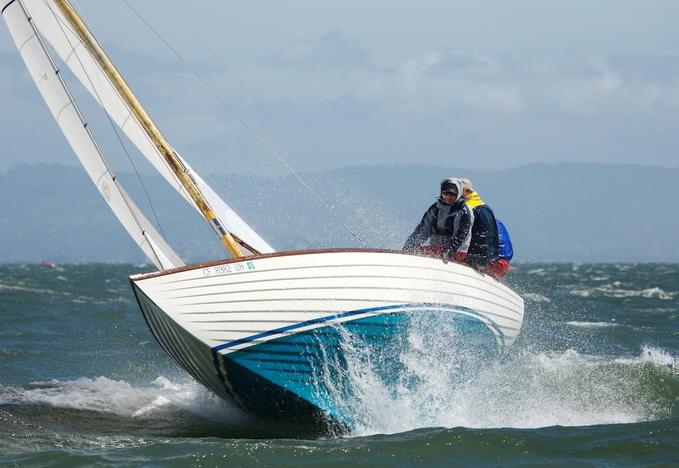
On top of that, she's easy to handle. A picture of IF Boat 377 (Magnificent Obsession) published in Latitude 38 magazine in June, 1998, shows her rail down just outside San Francisco's G olden Gate in 25 knots and more. She has one reef in the mainsail and full working jib—and her tiller is being held dead fore-and-aft. No weather helm there.

The Folkboat is indeed revered for her ability to carry sail in strong winds, and no doubt her extra-heavy keel is largely responsible for this. The ballast ratio is an extraordinary 54 percent, which means the iron keel alone weighs more than all the rest of the boat. Little wonder that Folkboats were, and still are, so popular in the blustery San Francisco Bay area.

Her performance as a seaboat is legendary, of course. It wasn't just a coincidence that two of the six boats in the first Singlehanded Transatlantic Race, in 1960, were Folkboats. Valentine Howells raced in the conventional Folkboat Eira, while Colonel H. G. ("Blondie") Hasler sailed a much-modified Folkboat, the famous Jester, which had a standard hull but a flush deck with a central control point and a Chinese lug rig.

The long keel gives the Folkboat good directional stability, and this, together with her zesty performance and her easy motion, makes her a sensible choice for a singlehanded voyager or a young couple—and we say a young couple only because young p eople are more likely to be forgiving about the Folkboat's biggest disadvantage, her lack of interior space.

Known weaknesses
After nearly 60 years of production and real-life testing, there are no weaknesses left in the Folkboat that are not patently obvious, such as the cramped accommodation quarters. This is a very open, honest boat.

If you're contemplating buying one for a long voyage, you'll have to look for the wear and tear applicable to boats in general. Inspect the hull for the dreaded boat pox, if she's GRP, and be careful to locate any areas of rot if she's wooden. Dance on those fiberglass decks and tap away with your screwdriver handle.

As always, even if you think you know it all, it's a wise move to get a second opinion. Let a qualified surveyor check her out. It's your life that's at stake.

Owner's opinions
This is another boat people fall in love with so passionately that it's difficult to get an owner to say a word against a Folkboat. Her classic beauty alone is enough to still all criticism.

Yet the physical exploits of her devotees give us valuable insights into her abilities when the sole arbiter is the sea itself. Blondie Hasler's wooden Jester is both a good and a bad example of this. Good, because she crossed the Atlantic 14 times. Ba d, because she was eventually lost at sea without trace. But she was very old and she had suffered more punishment than a dozen normal boats.

From the waterline down, Jester was a normal Folkboat, but the rest of her had been greatly modified by her owner, who was much given to invention and experimentation. She was a very early model, and in fact sailed from 1952 to 1959 with Hasler's "lapw ing" rig before he threw that out and installed a junk rig for the 1960 Observer Singlehanded Transatlantic Race.

Hasler came in second in that race, a remarkable achievement. He was only eight days behind Francis Chichester's Gipsy Moth III a much bigger and faster 39-foot sloop that crossed the finish line 40 days after the start. Jester was driven hard, and was reduced in one gale to what Hasler described as "four reefs down."

The other Folkboat in that race, Eira, came in fourth out of six in 63 days. Eira was knocked on her beam ends, and Valentine Howells put into Bermuda to replace a chronometer he had lost and to repair some damage.

In 1963, Adrian Hayter circumnavigated the world alone, sailing halfway—from England to New Zealand—in Sheila II, a 32-footer. But he completed the New Zealand-to-England leg in a Folkboat called Valkyr. Mike Bale also sailed from England to New Zealand in a Folkboat called Jellicle, and had a crew for part of the way. In 1975, a 55-year-old Australian grandmother named Ann Gash sailed around the world singlehanded in a Folkboat called Ilimo. She chose the east-to-west route via the Panama Ca nal, but had the boat shipped for part of the way, from Ghana to England.

More recently, a British Folkboat called Storm Petrel was completing an unusual circumnavigation in 1998 with solo sailor Tony Curphey aboard. It was unusual because Tony's wife, Suzanne, was also making a singlehanded circumnavigation aboard her own b oat, a 30-foot Seadog ketch called Glory. They had originally set out separately, not knowing each other, but they met in New Zealand and got married in the Solomon Islands.

Tony's Folkboat often beat Suzanne's Seadog into port on subsequent legs of their tandem voyage and regularly clocked up 130 miles a day in the trade winds. Their plan, once they had completed their solo circumnavigations, was to sell their boats, buy a bigger one, and carry on cruising—but together this time.

There are undoubtedly many other Folkboats that have sailed around the world and around Cape Horn, singlehanded and crewed, whose names have not been recorded in the annals of small boat sailing. There was a time, 50 years ago, when such voyages were r are, and records were kept of individual exploits. Now that they are more commonplace, nobody seems to be keeping the tally, which is a great pity. Perhaps the Internet will one day find a place for the Roll of Honor of small boat circumnavigations; if it does, the Folkboat will surely feature prominently.

Conclusion
According to Marek Janiec, a member of the Swedish International Folkboat (IF) Association's technical committee, there are about 2,000 IFs in Sweden, and the market price there for a boat in excellent con dition is about 60,000 Swedish kroner, or $7,400 U.S. There are about 4,000 IF Boats scattered throughout the globe, which makes it the biggest deep-keel racing class in the world.

"In Denmark, the price is 20 percent to 30 percent higher, and down in Europe, still 20 percent more."
So—would you score a financial coup by going to Sweden, buying a cheap Folkboat, and sailing her home? Probably not, although it's a very attractive plan, in any case. Secondhand International Folkboats sell on the West Coast of the United States for between $10,000 and $14,000, so the savings are not substantial in actual dollar terms if you factor in travel and accommodation charges. A brand-new fiberglass Nordic Folkboat costs about $40,000 in Denmark.

Wherever you buy one, a Folkboat represents good value for a boat capable of carrying one or two people around the world, albeit in cramped surroundings. Besides that, if you have any finer feelings at all, you'll have to agree that she's one of the mo st beautiful boats ever made to go to sea. Just looking at her riding to anchor in her own reflection in a tropical lagoon will make your heart leap with delight.

Text from The Nordic Folkboat: Little Beauty with a Big Heart by John Vigor.

Also, a here is a link to Sea Room a film featuring the Folkboat about the 1976 St. Francis Yacht Club's Woodie Regatta in the San Francisco bay.
 

This little Folkboat was built between 1964 and 1965, probably in one of the original Scandinavian Folkboat shipyards. She is in very good condition and was sailing earlier this summer, but could definitely use some love and attention. Her exterior varnish is a bit shabby and the electronics haven't been used in a while. She is possibly the only Folkboat on the Great Lakes. Equipped with riding lights, fog horn, oil lamp, lit binnacle, and four berths, she should make a fantastic cruising boat, or even enter some races with an appropriate handicap... I am sure there will be many more stories to come from adventures on this little beauty. 

Edward Lear by W. H. Auden

Left by his friend to breakfast alone on the white
Italian shore, his Terrible Demon arose
Over his shoulder; he wept to himself in the night,
A dirty landscape-painter who hated his nose.

The legions of cruel inquisitive They
Were so many and big like dogs: he was upset
By Germans and boats; affection was miles away:
But guided by tears he successfully reached his Regret.

How prodigiuous the welcome was. Flowers took his hat
And bore him off to introduce him to the tongs;
The demon's false nose made the table laugh; a cat
Soon had him waltzing madly, let him squeeze her hand;
Words pushed him to the piano to sing comic songs;

And children swarmed to him like settlers. He became a land.

from W.H. Auden, Collected Shorter Poems 1927-1957,
London, Faber and Faber, 1966, p. 127.

St. Kiven and the Gentle Kathleen

By Thomas Moore
E L's illustrated Version
 
 
No. 1
By the lake whose gloomy shore
Skylark never wobbles oer—
Where the cliffs hang high & steep—
Young Saint Kiven stole to sleep.


No. 2
Here at least, he calmly said
Woman ne'er shall find my bed
Ah! the good saint little knew,
What that wily sex can do.—


No. 3
Twas from Kathleens eyes he flew,
Eyes of most unholy blue,
She had loved him well & long—
Wished him her's, nor thought it wrong.


No. 4
Wheresoe'ever the saint could fly,
Still he heard her light foot nigh,

Illustration Lost
No. 5
East or west, where'er he turn'd,
Still her eyes before him burn'd.


No. 6
On the bold cliff's bosom cast,
Tranquil now he sleeps at last;
Dreams of heaven, nor thinks that e'er,
Woman's smile can haunt him there.
But nor earth nor heaven is free,
From her power, if fond she be:—
Even now, while calm he sleeps—
Kathleen o'er him leans and weeps.
Fearless she had trackd his feet
To that rocky wild retreat—
And when morning met his view
Her mild glances met it too.


 No. 7
Ah! yes saints have cruel hearts—
Sternly from his bed he darts
& with rude repulsive shick
Hurls her down the beetling rock.


 No. 8
Glendalough, thy gloomy wave
Soon was gentle Kathleens grave,
Soon the Saint, but ah too late
Felt her love, & mournd her fate;


 No. 9
When he said, 'Heaven rest her soul—
Round the Lake light music stole—
And her ghost was seen to glide,
Smiling — oer the fatal tide.

Maps from Books I

The Jumblies
by Edward Lear 

"For they'd been to the lakes, and the Torrible Zone,
And the Hills of the Chankly Bore...."


I thought this was an appropriate map to begin this series of posts. Edward Gorey illustrated a version of The Jumblies published in 1968 with this wonderful image of the the far side of the Western Sea. It measures 14 x 42 cms.

The Youthful Cove

In medio Tutorissimus ibis.
"Thou shalt walk in the midst of thy Tutors."


ONCE on a time a youthful cove
As was a cheery lad
Lived in a villa by the sea.—
The cove was not so bad;

The dogs and cats, the cows and ass,
The birds in cage or grove
The rabbits, hens, ducks, pony, pigs
All loved that cheery lad.

Seven folks—one female and six male,—
Seized on that youthful cove;
They said—"To edjukate this chap
Us seven it doth behove."

The first his parrient was,—who taught
The cove to read and ride,
Latin, and Grammarithemetic,
And lots of things beside.

Says Pa, "I'll spare no pains or time
Your school hours so to cut,
And sqare and fit, that you will make
No end of progress—but—,"

Says Mrs. Grey,—"I'll teach him French,
Pour parler dans cette pays—
Je cris, qu'il parlera bien,
Même comme un Francais—Mais—"

Says Signor Gambinossi,—"Si
Progresso si farà,
Lo voglio insegnare qui,
La lingua mia,—ma,"—

Says Mr. Grump,—"Geology,
And Mathetics stiff
I'll teach the cove, who's sure to go
Ahead like blazes,—if—"

Says James—"I'll teach him everyday
My Nastics: now and then
To stand upon his 'ed; and make
His mussels harder,—when"—

Says Signor Bianchi,—"Lascia far;—
La musica da me,
Ben insegnata gli serà;—
Farà progresso,—Se—"

Says Edmund Lear—"I'll make him draw
A Palace, or a hut,
Trees, mountains, rivers, cities, plains,
And p'rapps to paint them—but—

So all these 7 joined hands and sang
This chorus by the sea;—
"O! Ven his edjukation's done,
By! Vot a cove he'll be!"

Tennyson, To Edward Lear on His Travels in Greece

Illyrian woodlands, echoing falls
Of water, sheets of summer glass,
The long divine Peneian pass,
The vast Akrokeraunian walls,

Tomohrit, Athos, all things fair,
With such a pencil, such a pen,
You shadow forth to distant men,
I read and felt that I was there:

And trust me while I turn'd the page,
And track'd you still on classic ground,
I grew in gladness till I found
My spirits in the golden age.

For me the torrent ever pour'd
And glisten'd -- here and there alone
The broad-limb'd gods at random thrown
By fountain urns; -- and Naiads oar'd

A glimmering shoulder under gloom
Of cavern pillars; on the swell
The silver lily heaved and fell;
And many a slope was rich in bloom

From him that on the mountain lea
By dancing rivulets fed his flocks,
To him who sat upon the rocks,
And fluted to the morning sea.

And Lear's parody:

Delirious Bulldogs; -- echoing calls
My daughter, -- green as summer grass; --
The long supine Plebeian ass,
The nasty crockery boring falls; --

Tom-Moory Pathos; -- all things bare, --
With such a turket! such a hen!
And scrambling forms of distant men,
O! ain't you glad you were not there!

Bravissimo, Signore!

"Being of an undiplomatic and demonstrative nature in matters that give me pleasure, I threw the paper up into the air and jumped aloft myself--ending by taking a small fried whiting out of the plate before me and waving it round my foolish head triumphantly till the tail came off and the body and head flew bounce over to the other side of the table d'hote room. Then only did I perceive that I was not alone, but that a party was at breakfast in a recess. Happily for me they were not English, and when I made an apology saying I had suddenly seen some good news of a friend of mine, these amiable Italians said, 'Bravissomo, Signore! We too are delighted! If we had some little fish also, we would be throwing them all over the room with you!' - so we ended by all screaming with laughter."

-Edward Lear in a letter to Lady Wladegrave

From Lear's Italy: In the Footsteps of Edward Lear

Sir Edward Strachey's Introduction to Lear's Nonsense Songs and Stories

By Sir Edward Strachey, Bart.

What is Nonsense? I know when you do not ask me. I know that in infancy it is as the very air we breathe; that it cheers and strengthens us in the long weary working ways of manhood; and brightens and gladdens our old age. But how can I bring it within the words of a definition? If the question is pressed, I must answer it with another. What is Sense? Sense is the recognition, adjustment, and maintenance of the proper and fitting relations of the affairs of ordinary life. It is a constitutional tact, a keeping touch with all around it, rather than a conscious and deliberate action of the intellect. It almost seems the mental outcome and expression of our five senses; and perhaps it is for this reason, as well as because the sense of the individual always aims at keeping itself on the average level of his fellows, that we usually talk of sense as Common Sense. If we call it Good Sense, it is to remind ourselves that there is a right and a wrong in it as in everything human. But it is not Bad Sense, but Nonsense which is the proper contrary of Sense. In contradiction to the relations and harmonies of life, Nonsense sets itself to discover and bring forward the incongruities of all things within and without us. For while Sense is, and must remain, essentially prosaic and commonplace, Nonsense has proved not to be an equally prosaic and commonplace negative of Sense, not a mere putting forward of incongruities and absurdities, but a bringing out a new and deeper harmony of life in and through its contradictions. Nonsense in fact, in this use of the word, has shown itself to be a true work of the imagination, a child of genius, and its writing one of the Fine Arts.

From the days when Aristotle investigated the philosophy of laughter, and Aristophanes gave laughter its fullest - I might say its maddest - expression on the stage at Athens, down to this week's issue of "Punch," Nonsense has asserted and made good its claim to a place among the Arts. It has indeed pressed each of them in turn into its service. Nonsense has found the highest expression of itself in music, painting, sculpture, and every form of poetry and prose. The so-called Nonsense Club, which could count Hogarth and Cowper among its members, must have been worthy of the name, for so we have the "March to Finchley" and "John Giplin" to testify; but as far as I know, Edward Lear first openly gave Nonsense its due place and honour when he called what he wrote pure and absolute Nonsense, and gave the affix of "Nonsense" to every kind of subject; and while we may say, as Johnson did of Goldsmith, that there was hardly a subject that he did not handle, we may add with Johnson, that there was none that he did not adorn by his handling. His pen and pencil vied with each other in pouring forth new kinds of Nonsense Songs, Nonsense Stories, Nonsense Alphabets, and Nonsense Botany. His visit to India supplied him with matter for what I might call Nonsense Philology and Nonsense Politics; and ever since his death I have been able to add two new forms of his Nonsense, an Eclogue with the true classical ring, or the Heraldic Blazon of his Cat Foss; the music to which he set the "Pelican Chorus" and the "Yonghy Bonghy Bo" is worthy of the words to which it is wedded; and those who remember the humorous melancholy with which the old man sat down at the piano to play and sing those songs, will give his Nonsense Music a place too.
But "pure and absolute" as Edward Lear declared his Nonsense to be, he was no mere buffoon. His own sketch of his life, given in another part of this volume, and fully confirmed by all that he has left behind him, shows him to have been a conscientious lover of hard work, from the time when, at the age of fifteen, he began to earn "bread and cheese" by selling his "queer songs and sketches," at prices from ninepence to four shillings. This love of hard work is so characteristic of genius, that a great man has (no doubt with some exaggeration) made the capacity for taking infinite pains a definition of genius itself, while the individual humour which is shown in Lear's pictures is itself the sufficient proof of his genius. He was a landscape painter of individual power. The mere list of the books of Natural History which he illustrated; of the many and distant lands which, poor and weak in health, he visited; and his journals and records of these places, "with such a pencil, such a pen," is enormous; and all this while he was carefully cultivating and training himself in the proper work of an artist, which was the real business of his life. And while it is true that, without all this preparation, the Books of Nonsense could not have been written, it is true also that they are only the outcome and overflow of a life which was no less serious and noble than genial and loving. Like Shakespeare, he understood that all merriment should be held "within the limit of becoming mirth," and this limit he found for himself in his fondness for children, - "he loved to see little folks merry," - and in that habit of doing conscientious and finished work which characterises the true artist. He gives an account for the beginning and growth of this work in the Introduction to his "More Nonsense," to which I refer the reader. I have myself said more elsewhere on a subject which has for me a never-ending interest. I will rather give here an account of a visit paid by my son Henry to our old friend:-

"When staying at Cannes at Christmas 1882, I was invited by Mr. Lear to go over to San Remo to spend a few days with him. Mr. Lear's villa was large, and the second he had built; the first became unbearable to him from a large hotel having been planted in front of it. So he put his new house in a place by the sea, where, as he said, nothing could interrupt his light until the fishes built. The second house was exactly like the first. This, Mr. Lear explained to me, was necessary, or else Foss, his cat, might not have approved of the new villa. At breakfast the morning after I arrived, this much-thought-of, though semitailed, cat jumped in at the window and ate a piece of toast from my hand. This, I found, was considered an event; when visitors stayed at Villa Tennyson, Foss generally hid himself in the back regions; but his recognition of me was a sort of 'guinea stamp,' which seemed to please Mr. Lear greatly, and assure him of my fitness to receive the constant acts of kindness he was showing me. Being an art student, my interest in Mr. Lear's paintings was as great as in his Nonsense, and I can vividly recall the morning spent in his studio, a large room upstairs. He was then at work on a series of water-colours, and his method seemed to be to dip a brush into a large wide-necked bottle of water-colour, and when he had made one or two touches on the drawing, to carry it to the end of the room and put it on the floor, the performance being repeated until quite a row was arranged across the room. Downstairs he had a gallery lighted from the top, which had many beautiful water-colours along the walls, and one great canvas of Mount Athos, which seemed finished, but which he was always making experiments upon in white chalk. At the end of the gallery stood a huge canvas, I think it was 18 feet long, covered over with lines in squares, but no drawing on it. This, he told me, was to be a picture of Enoch Arden on the desert island. My remark that this would be a great undertaking roused Mr. Lear to declare warmly that an old man must never relax his efforts or fail to attempt great things because he was seventy. I could not, however, but feel that there was some inconsistency between this and his habitually saying he was going to live two years longer, and no more. Mr. Lear as an artist was by sympathy a pre-Raphaelite; he was not one of the original brotherhood, but considered himself a nephew of the originators of the movement, and he told me he had written to his friend, Sir John Millais, 'My dear aunt, I send you a drawing of my cat to show you how I am getting on.'

"Mr. Lear told me that, as a boy, his voice being a good one, he used to be taken to sing at artists' parties, and he was very proud of once having heard Turner (whose art he worshipped) sing a song. Apparently there was no great matter in the ditty, and the note was very untuneable, for Turner had neither voice nor ear. The refrain Mr. Lear remembered, and used to hum, chuckling to himself, 'And the world goes round a-bound, a-bound.' Mr. Lear told me that he approved of the saying of some one, 'Study the works of the Almighty first, and Turner next.' Once meeting a friend who had stayed in a house where Turner was painting, Mr. Lear anxiously asked, 'Cannot you tell me something the great man said?' 'He never said anything,' was the reply.

"Mr. Lear's household arrangements were peculiar. Three brothers, young Albanians, - sons of his old servant Giorgio, - did all the housework and cooking, and the youngest, a youth of seventeen, he looked after with fatherly care. He had taught him to say the Lord's Prayer with him every evening, telling me how he felt it his duty to prevent the young man growing up without religion, and expressing his horror of a godless world.

"Mr. Lear was by temperament melancholy; it was not the grave air assumed by a humourist to give his jokes more point, but a gentle sadness through which is humour shone. He felt keenly the neglect of the world for his pictures, but he seemed anxious to prevent all but the nearest friends seeing them. When I was staying with him, it happened to be the afternoon on which he was supposed to be at home to show his pictures to possible buyers. Early in the afternoon he told me that he sent his servants out, and was going to open the door himself. He explained that if any one came he did not like he could send them away, and also keep out Germans. He seemed to have a great horror and fear that a German might be let in by accident. What caused this fear I was not able to discover. As the afternoon advanced a ring at the door-bell was heard, and Mr. Lear went to open the door. Sitting in the gallery, I heard the voice of a lady inquiring if she could see the pictures, and I could hear Mr. Lear, in a voice of the most melancholy kind, telling her that he never showed his pictures now, he was much too ill; and from his voice and words I have no doubt the lady went away with the idea that a most unhappy man lived here. Mr. Lear came back to the gallery with much satisfaction at the working of his plan, which was so far superior to the servant's 'Not at home,' as by his method he could send away bored and let in people he liked. Later on, some friends he wanted to see came, and the melancholy old man, too ill to show his pictures, changed into the most genial host. In the evenings he often sang; the 'Yonghy Bonghy Bo' was inimitable. His voice had gone, but the refinement and expression was remarkable. His touch, too, was finished and smooth; unfortunately his playing was by ear, so that many of the really beautiful songs he composed were lost. One such still haunts me; the words, Tennyson's 'In the Garden at Swainston,' were set to most touching and appropriate music. I think he felt the words very strongly; they echoed his own feelings; he had outlived many friends, and many dead men 'walked in the walks' with him. He showed me a long frame with photographs of his friends in it; it hung in the drawing-room, but there were several blank places. He told me when a friend died his picture was taken out and put into a frame hanging in his bedroom. This melancholy never soured his mind nor stopped his matchless flow of humour and bad puns; but it coloured them all. My visit to Villa Tennyson coming to an end, on the last evening after dinner he wrote a letter for me to take back to my father, sending him the then unpublished conclusion to Mr. and Mrs. Discobbolos; and when this was done he took from a place in his bureau a number of carefully cut-out backs of old envelopes, and on these he drew, to send to my sister, then eight years old, the delightful series of heraldic pictures of his cat. After he had done seven he said it was a great shame to caricature Foss, and laid aside the pen.

"The next day ended my visit - one which I shall ever remember. The touching kindness which marked all his actions towards me I shall never forget; and I still see the tall, melancholy form, with loose clothes and round spectacles, leaning over the railings of the San Remo railway station, though happily I did not then know that I was looking on that kindly figure for the lasy time. H. S. "

In conclusion, and as counterpart to this account of the good old man and his household, let me commend to the reader the autobiographical sketches, to one of which I have already referred. They were published "By Way Of Preface" to a former edition of the present volume and are here reprinted.

Edward Strachey. Sutton Court, September 1894.

The Jumblies

Edward Lear

I
They went to sea in a Sieve, they did,
In a Sieve they went to sea:
In spite of all their friends could say,
On a winter's morn, on a stormy day,
In a Sieve they went to sea!
And when the Sieve turned round and round,
And every one cried, 'You'll all be drowned!'
They called aloud, 'Our Sieve ain't big,
But we don't care a button! we don't care a fig!
In a Sieve we'll go to sea!'
Far and few, far and few,
Are the lands where the Jumblies live;
Their heads are green, and their hands are blue,
And they went to sea in a Sieve.

II
They sailed away in a Sieve, they did,
In a Sieve they sailed so fast,
With only a beautiful pea-green veil
Tied with a riband by way of a sail,
To a small tobacco-pipe mast;
And every one said, who saw them go,'
O won't they be soon upset, you know!
For the sky is dark, and the voyage is long,
And happen what may, it's extremely wrong
In a Sieve to sail so fast!'
Far and few, far and few,
Are the lands where the Jumblies live;
Their heads are green, and their hands are blue,
And they went to sea in a Sieve.

III
The water it soon came in, it did,
The water it soon came in;
So to keep them dry, they wrapped their feet
In a pinky paper all folded neat,
And they fastened it down with a pin.
And they passed the night in a crockery-jar,
And each of them said, 'How wise we are!
Though the sky be dark, and the voyage be long,
Yet we never can think we were rash or wrong,
While round in our Sieve we spin!'
Far and few, far and few,
Are the lands where the Jumblies live;
Their heads are green, and their hands are blue,
And they went to sea in a Sieve.

IV
And all night long they sailed away;
And when the sun went down,
They whistled and warbled a moony song
To the echoing sound of a coppery gong,
In the shade of the mountains brown.
'O Timballo! How happy we are,
When we live in a Sieve and a crockery-jar,
And all night long in the moonlight pale,
We sail away with a pea-green sail,
In the shade of the mountains brown!'
Far and few, far and few,
Are the lands where the Jumblies live;
Their heads are green, and their hands are blue,
And they went to sea in a Sieve.

V
They sailed to the Western Sea, they did,
To a land all covered with trees,
And they bought an Owl, and a useful Cart,
And a pound of Rice, and a Cranberry Tart,
And a hive of silvery Bees.
And they bought a Pig, and some green Jack-daws,
And a lovely Monkey with lollipop paws,
And forty bottles of Ring-Bo-Ree,
And no end of Stilton Cheese.
Far and few, far and few,
Are the lands where the Jumblies live;
Their heads are green, and their hands are blue,
And they went to sea in a Sieve.

VI
And in twenty years they all came back,
In twenty years or more,
And every one said, 'How tall they've grown!
For they've been to the Lakes, and the Torrible Zone,
And the hills of the Chankly Bore!'
And they drank their health, and gave them a feast
Of dumplings made of beautiful yeast;
And every one said, 'If we only live,
We too will go to sea in a Sieve,---
To the hills of the Chankly Bore!'
Far and few, far and few,
Are the lands where the Jumblies live;
Their heads are green, and their hands are blue,
And they went to sea in a Sieve.