A short video showing the highlights of the machining process for the Janus Motorcycles fork top plate.
Showing posts with label Shape. Show all posts
Showing posts with label Shape. Show all posts

 l


The Tools of the Shadowcaster

Lead holder, small triangle, the all-important ruling pen, light, medium, dark and very dark shadow washes, a warm reflected light wash, and a variety of brushes.

The shadowcaster often works upside down depending on which way the shadow is graded. In this case the shadow is darkest at the top of the building.
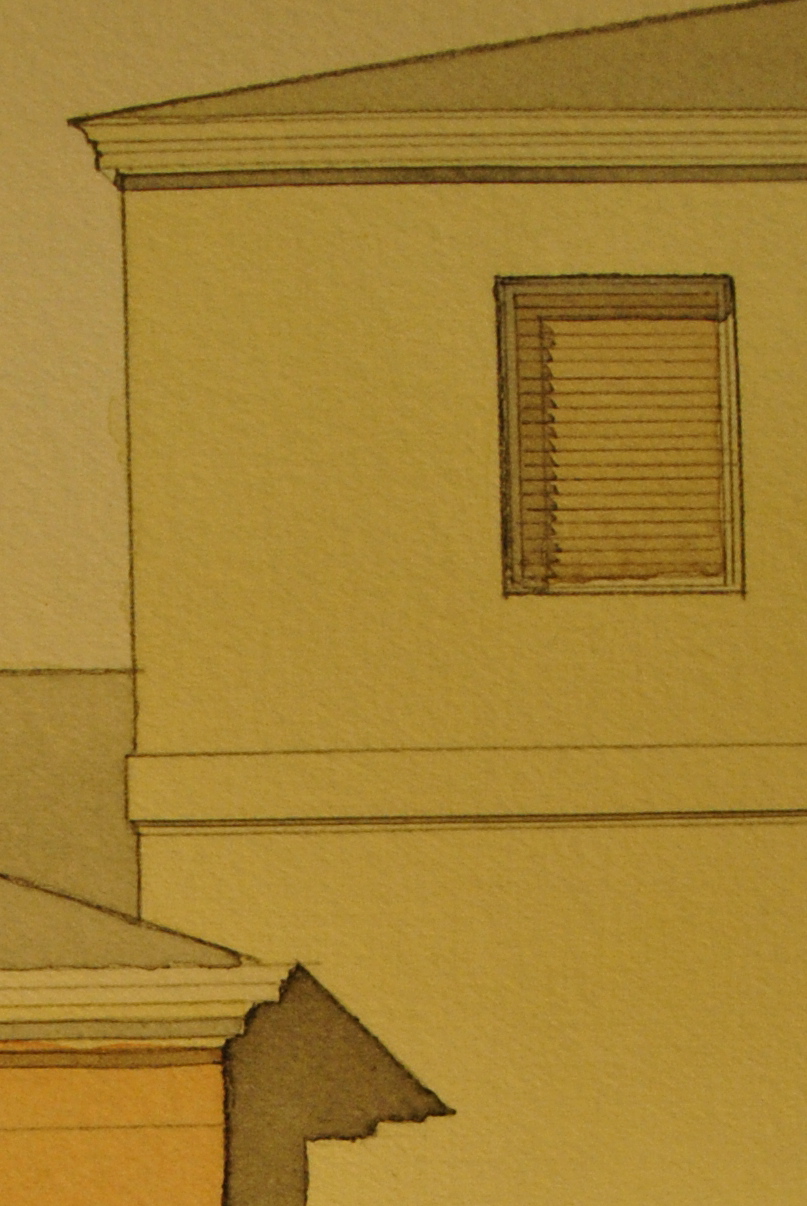
Even the masters make mistakes. Spot the mistake the shadowcaster has made in this detail and win a small dish of reflected light, or perhaps a vial of backshadow...


Draft Thesis Statement
Architecture embodies the ideal of the republican polity by civilizing the activity of commerce in the service of politics. The trading settlement may be a market but it is not of necessity a city. Only with the establishment of laws under the aegis of political wisdom can the settlement be organized to harness the prosperity of commerce. In so doing the city provides a place not only for the pursuit of sustenance, but of excellence. European (and by extension) American market halls are formally linked to the stoa, forum, basilica, loggia, exchange, and bourse, in that they provide a covered place to transact business within an ordered framework. Polities organize such spaces in order to assure a just commerce. In return the market takes care of the material needs of the city, and in the best cases, promotes the city’s prosperity. Without prosperity the city cannot achieve its end. Insofar as nature is composed of stable, unchanging classes of things, including those of human activity, architecture is capable of clarifying the structure of the city. Through the judicious use of the orders, the depiction of famous narratives of the city, and its overall suitability, architecture can provide a comprehensible framework conducive to the pursuit of the good life. Architecture thus functions rhetorically by embodying and explaining the order of the city by its imitation of nature. In the Western city, with economic freedom closely connected with urban life, the market and the polity are architecturally linked. The market hall is the heart or center of the city. It is in the building provided to house the public market that architecture in republican polities most significantly holds up the ideal of the good life lived in community and embodies the struggle between what is and what ought to be.


New Italian Helmet
MOMODESIGN

Casco dalla calotta rivestita da una speciale vernice opaca e particolari in vera fibra di carbonio. Gli interni sono estraibili e lavabili. Una funzionalità studiata in particolare per i frequent bikers e per i motociclisti della bella stagione. Il design di questo modello jet prende ispirazione dal casco degli elicotteristi. Al corpo del casco, rifinito artigianalmente, viene unita una visiera termoformata a bolla antigraffio, supportata da una piastra in fibra di carbonio. La calotta è rivestita con una speciale vernice ecologica opaca gommata, impreziosita da due decal del logo MOMODESIGN. Omologazione ECE 22.05

I have wanted one of these for a long time. Here in Italy it doesn't get much cooler than a flashy Momodesign helmet. Yes, I was going to get a full-face and be safe, but then... Matte black, carbon fiber, white lettering... Mine at last!
Maps from Books IV
The Hobbit
by J.R.R. Tolkien
by J.R.R. Tolkien

The Shire, my favorite of Tolkien's maps of Middle Earth.
Concinnitas, or Beauty Reconciled
What does Alberti mean by concinnitas? How does he learn what it is so that he can introduce it into his building? and what role, then, does concinnitas play in investing a building with beauty?
Concinnitas, Alberti’s powerful term for “the absolute and fundamental rule of Nature” denotes, with such a description and by its very nature, a difficult, and illusive theory. While Alberti makes no more specific statement than that concinnitas composes parts “according to some precise rule,” the very framework in which concinnitas is conceived will help the thoughtful architect, philosopher or political thinker in its pursuit, for concinnitas is more than a mere pattern book rule to be followed. Rather it is the way in which Beauty is reconciled to the particular example on earth. Concinnitas translates the ineffable idea of Beauty to us through minute adjustment of proportion, thereby rendering it perceptible to the senses. The pursuit of concinnitas is the highest goal of the architect, or indeed of man in general.
“Everything that Nature produces is regulated by the law of concinnitas, and her chief concern is that whatever she produces should be absolutely perfect.” Concinnitas flourishes in birth and death, in creation and destruction, and in every changing state between these extremes. Indeed, there can be no written formula for such an idea because it is not a static result, but a defining action whose very meaning is to take parts which are in every case different, and arrange them such that they form through their correspondence a complete and perfect whole. Concinnitas is the final and defining quality of architecture, or art in general. As such, it surpasses the crude necessities of shelter and protection, enters the realm beauty, and becomes something that arouses delight in the beholder.
Thus, a discussion of concinnitas must begin with the understanding that it is something which governs both the practical and aesthetic qualities of building; it is behind and above decisions concerning the material or order of building. What Alberti is telling us is that no truly functional thing can be made without concinnitas, and that any discussion of concinnitas must therefore govern and surpass that of firmness and commodity. Architecture, Alberti tells us, in agreement with Vitruvius, is worthy of praise when it is commodious, firm, and delightful. Yet for Alberti, the final requirement is the most vital. “Of the three conditions that apply to every form of construction – that what we construct should be appropriate to its use, lasting in structure, and graceful and pleasing in its appearance – the first two have been dealt with and there remains the third, the noblest and most necessary of all.” In other words, firmness and commodity are necessities not just of a palazzo, but also of a barn. What sets great buildings apart is that they delight our senses with the beauty arising from their proportions, not just relative to themselves, but to the cosmos.
“All care”, he tells us, “all diligence, all financial consideration must be directed to ensuring that what is to built is useful, commodious, yes – but also embellished and wholly graceful, so that anyone seeing it would not feel that the expense might have been invested better elsewhere.” Thus, architecture for Alberti is most concerned with beauty, in that every good which architecture brings to humanity is a result of its grace and appropriateness. “To have satisfied necessity is trite and insignificant, to have catered to convenience unrewarding when the inelegance in a work causes offense.” The task of the architect is to reach beyond necessity and evoke pleasure in the viewer. This is accomplished through concinnitas.
Central to Alberti’s theory of concinnitas is the idea that architecture is a composition of various individual parts that follows a rational arrangement. Beauty, Alberti tells us, “is that reasoned harmony of all the parts within a body, so that nothing may be added, taken away, or altered, but for the worse." It is in the correct manipulation of these elements that beauty is achieved. “When you make judgments on beauty, you do not follow mere fancy, but the workings of a reasoned faculty that is inborn in the mind… for every body consists entirely of parts that are fixed and individual; if these are removed, enlarged, reduced, or transferred somewhere inappropriate, the very composition will be spoiled that gives the body its seemly appearance.”
The theory of concinnitas is grounded in a perfect composition of the various parts. If these elements such as cornices, windows, walls, columns, doors, and porticoes are altered from their perfect manifestation in the whole, concinnitas will no longer be present in the work. Indeed, one might also say that, just as a “reasoning faculty is in born in the mind,” so too a “natural excellence” exists as a potential in every building. The individual building in this description already exists as a perfect idea which the art of the architect attempts to emulate. In other words, a failure to correctly arrange the parts according to the rules of concinnitas regulating the composition of the whole will results in an unsuccessful building, or one that does not attain the perfection it is innately capable of.
How then do we achieve this proportionate arrangement? If beauty is the reasoned harmony of all the parts, then that harmony may be described, Alberti tells us, using Number, Outline and Position. For Alberti number was a quantitative relationship between things in a formula, but more importantly, it was also a qualitative entity in its own right. As George Hersey so beautifully explains there were whole churches, cities, kingdoms and heavens of numbers, each with its own particular character and even genealogical structure. Outline is difficult to understand as it can mean several things. I believe it is directly tied to Alberti's idea of lineamente, or the lines and angles, which form the building (as opposed to the material, or structura). Regardless, it is something like the form, or type of the building, in that in the outline informs us of the building's purpose (to some degree this is also accomplished by ornament). Branko Mitrovic has called lineamente shape, which I think is not far from the truth. Position has to do with Alberti's use of the term collocation, or the placement of the parts of a body in such a relationship that the whole, which they form, has the quality of beauty. We will return to this.
“But,” Alberti continues, “arising from the composition and connection of these three is a further quality in which beauty shines full face: our term for this is Concinnitas; which we say is nourished with every grace and splendor. It is the task and aim of concinnitas to compose parts that are quite separate from each other by their nature, according to some precise rule, so that they correspond to one another in appearance.” In other words, concinnitas takes varying numbers of things which have different shapes, and lie in various positions, and creates (according to a “precise rule”) a complete and beautiful whole.
Concinnitas is not simple the combination of number shape and position, or a glorification of just of position, rather it is the manipulation of the three qualities such that each is altered to form a suitable and distinct whole, appropriate for its unique location and purpose on earth. To make this distinction more apparent, let us even say that position is sufficient to compose a literal version of a building’s heavenly counterpart, but that concinnitas breaths the life into an otherwise inanimate copy. Concinnitas fractures the perfect harmony of ideal beauty just enough for man to comprehend it. In short, concinnitas is like the bending of a perfect rectangle to fit the curvature of the globe it would otherwise be incompatible with.
Subscribe to:
Posts (Atom)