82-year-old grandfather Ted Fenwick wins opening race of the Isle of Man TT fortnight

From the York Press
Monday 7th June 2010

ANYBODY who thought the world of high-powered motorbike racing is a young man’s game should try telling that to Ted Fenwick.

The 82-year-old grandfather from York left his rivals trailing in his wake when he led from start to finish to win the opening race of the Isle of Man TT fortnight, one of the biggest events in the sport’s calendar.

Mr Fenwick, from Heworth, York, beat competitors a quarter of his age on his 250cc Ducati, which he first rode 28 years ago. He triumphed in the Pre-TT Classis on the island’s Billown circuit for the third time, having finished runner-up in both of the previous two years.

Having caught the motorbiking bug as a teenager and with 58 years of racing, plus his share of broken bones, under his belt, he has no plans to retire just yet.

He said: “I just enjoy riding the bike and I enjoy competing, because I get a real thrill from the speed of it.

“A lot of the people I race against are much younger and probably more fearless, but it doesn’t really matter, although when I started racing I never thought I would still be doing it now.

“I’ve been in hospital with things like a fractured pelvis and I broke my neck, arm and back in 1968, but I haven’t had a serious injury since 1972 and I’ll keep racing as long as I keep getting up in the morning.”

Mr Fenwick insists his success and longevity is a team effort between him and his friend Geoff Shaw, who is in charge of preparing the bike for events, and said: “I couldn’t do it without him.

“My wife Margaret is also very supportive, although she would still be pleased if I stopped racing. But while I wouldn’t say I’ve got better with age, I’ve definitely become more careful.”

The Pre-TT Classic races are run by the Southern 100 Motorcycle Racing Club, whose secretary, George Peach, said: “For a man of Ted’s age to still be competing and winning is absolutely amazing.

“He doesn’t look in his eighties and he certainly doesn’t act it. He’s a superb rider, he thoroughly deserved to win and everybody was delighted for him.”


Thanks to the Vintagent for the tip...

Emulation

I just stumbled on the blog of Emulatio, a professor of architecture at the University of Notre Dame. He extols the virtue of "emulation" in contrast to imitation. In his own words: 

"EMULATION is a word that sums up our culture's missing link with the beauty of the past: neither humble imitation nor adventurous invention (although both have their place), emulatio means a competitive desire to equal or surpass previous achievements on their own terms. If there is an understanding of the past for which popular caricatures of servile imitators or romantic "creators" ill-prepare us, it is this, and laying out how we can recover its balance of respect and aspiration will be a lot of what I aim to address. I hope you'll find it rewarding reading."

I'm not so sure imitation is quite so "humble."

Towel Day

If you are a frood who really knows where his towel is, then you already know that Towel Day is in 14 days...

I brew my beer I bake my bread...


Fifty-six bottles of home-brewed American style all wheat. I sampled some of the stuff before we bottled it and, minus carbonation, it tasted delicious. Now I just have to wait.

 
And yes, I did use a large wooden spoon.

Velocity Stacks and Garden Tractors

I experienced the unexpected thrill this weekend of a garden tractor pull in Shipshewana, heart of Indiana Amish country. While there were of course no Amish entrants in the event, the gray-hatted boys seemed quite interested, gathering around the machines as they prepared for their run in front of the adjustable weight.

Thrill might be a bit of an exaggeration; tractor pulls in general usually attract a very specific audience... That said, large tractor pulls are certainly a bit more exciting with a lot more power accompanied by massive wheelies, but my appreciation of small engine tuning was well rewarded with velocity stacks galore, massive carburators, and homemade exhaust systems--even if they were all four-stroke.

 
While most of the smaller tractors retained there starters, all of the more powerful machines required this interesting dolly mounted starter. Since tractor engines are longitudinally mounted this device was simply wheeled up next to the tractor and a belt run from the electric motor mounted at the top of the dolly. The car battery at the foot of the dolly kicks over the started and the tractor fires to life, while the belt slips harmlessly off.   

Critical Consciousness and the Unchanging in Architecture

‹‹Bisogno fare qualsiasi cosa, fuorché l’invenzione di cose nuove: la vera invinzione è il non inventare nulla. Chi si rende consapevole di tutta l’inventabilità dell’inventabile è colui che non inventa nulla, perché ormai tutto quello di cui è capace questo nostro sistema planetario è già stato prodotto, ed è tutto qui: più esso sarà reinventato e piu sara posto in crisi. 
Ma occorre viceversa capirlo.
Dunque pianificare vuol dire lasciare lavorare la realtà, comprendendone il senso del miglior utilizzo››.

S. Muratori, Autocoscienza e realtà nella storia delle ecumeni civili, a cura di G. Maranucci, Roma 1976.


One question is of singular importance to the contemporary architect attempting to return to the classical tradition amidst the dissolving wake of the modernist movement. That question is “what is unchanging in architecture?” Tradition, in this sense, is the means by which we access truth. The adjective classical denotes works of architecture which are prized as the finest exemplars of a tradition. These are held up as models for the guidance of current practice and for the assurance of future success. Therefore, the form that the examples in a classical tradition take is necessarily contingent on the material requirements and propriety connected with both time and place.

The classical architecture of one era will not take shape in the same way as that of another, nor will the architecture of one place necessarily resemble that of a different place even at the same time. Conventions such as patterns of use, fashion, language and ways of building change over time and in different places, gaining their correctness through general acceptance and habit. This accepted knowledge and these skills and customs—-means by which we pursue the true, the beautiful and the good—-are guarded and handed on by the custodians of tradition to succeeding generations. As part of this transfer, the means of accessing truth is developed and changed according to the requirements of time and place. The tradition of one place may not be the same as that of another. The purpose of tradition is to bring into conformity the way we each pursue our ends in the particular with the best possible means of achieving those ends in the universal. In other words, tradition is the way in which our judgment is informed through the comparison of the way things are with the way things should be. Thus tradition is not about preserving a unique way of building, but of ensuring that our buildings are the best they can possibly be.

The concept of imitation is essential to an understanding of tradition. The idea of mimesis, first formulated by Aristotle in his Poetics, became an explicit principle of creative formation and procedure from ancient Greece until the end of the Renaissance.[i] As James Ackerman has noted, the concept of imitation was understood in two ways both for the ancients and the thinkers of the Renaissance.[ii] Imitation in art occurred both in mimesis—the imitation of nature or human behavior, and in the imitation of preceding artists. The first mode of imitation forms the framework in which moral judgment is made possible, while the second provides a means of translating these universal truths for a particular time and place.

Imitation, as Quatremere de Quincy enunciated as late as 1823, was seen not as mere copying of natural forms or previous works, but as the embodiment of apparent universal rules governing the production of beauty in the work of art.[iii] These rules could be extracted from nature and perfected over time through the imitation of predecessors in a tradition. As Ackerman points out, imitation is inherently forward looking. By this he means that the artist is able to use imitation during the creation of the work of art. This view is in opposition to that of modern art historians who use the concept of “influence,” an idea only debatable after the creation of the work of art and in the service of the art historian.[iv]

How are we then to judge what is essential in a tradition? What can be discarded in the face of improved technology, or to suit changing political or physical conditions? This question has undoubtedly been the starting point of all architectural endeavors and probably troubled the architects of the fourteenth century as much as it did the proponents of the eighteenth and nineteenth century revivals. In a world so full of varying forms it has been difficult to determine what concepts and categories should guide contemporary practice. Compounded with a seeming abundance of choices, the void left by modernism’s denial of tradition has exaggerated its self-proclaimed goal of severing us from the past. We are faced not only with the questions raised by the contingent reality of tradition itself, but by any attempt to restore a tradition that has been systematically eradicated.

As citizens of the United States our tradition is that of the West. This is not to say that the tradition of Greco-Roman-Judeo-Christian architecture is the only one in our country, or the first, but that it is the visible part our “life, liberty and the pursuit of happiness.” The need to separate our new republic from the colonialism of England and justify our classically derived system of government prepared the United States for the embodiment of its constitution in an architecture of Western classicism. Little wonder that the author of the Declaration of Independence should also design the new Capitol of Virginia using the classicism of the Roman temple.

Fiske Kimball in his American Architecture asserts that “the classical ideal thus embodied was ultimately to rule in America to a degree unknown in Europe.”[v] Indeed, it was to precede it by more than a decade. The embodiment of the political order in the architecture of America is significant in that it points to the most essential truth of the classical tradition: the understanding that the highest good in life is the perfection of our nature, a good held since the Greeks to be accomplished through the moral life led in community. This is the self-evident truth behind the most just political systems of the past and the guiding principle in the American founding.

What this understanding means for architecture is that our ability to pursue our highest end as individuals is dependent on the freedom insured by our government, and that architecture serves this good as the embodiment of the state.[vi] In other words, architecture is the visible part of the more important activity of politics. Conversely, it is only in the freedom provided by well-ordered politics that architecture can be pursued. Vitruvius opens his De re aedificatoria by noting that it is in the realm of peace brought about by the Emperor Augustus’ conquest of the world that the opportunity and need for civic buildings arose, thus grounding architecture in a particular relationship with politics.[vii] Not only can mere building become architecture, but architecture can embody the polity and legitimate its claim to authority. By doing so, it can establish the means for its citizens to pursue the moral life.

Traditions are necessarily conventional. This means that they are contingent on materials, climate and circumstance. Conventional knowledge is particular, temporal and accidental, meaning that it could have been otherwise. Limited by the contingencies of both time and place, knowledge of convention is gained from experience and hearsay. The best pitch of a roof is dependant on the climate and characteristics of the location. That there exists a hierarchy of architectural orders and that they include an architrave, frieze and corona is not necessarily true (although the predominance of such features across traditions could point to a correspondence with a larger order). So too, the rules governing a given order’s proportions may vary with the changing requirements and traditions of the building and its purpose. Gaining as they do their acceptance through trial and error, such conventions are not necessary truths, or a priori knowledge, but point to a correspondence with an order outside of sense experience. Conventions have been adduced to be the best possible way of embodying the necessary truths of political life. Conventional knowledge on its own may be factually true and empirically verifiable, however, by its very nature it cannot be true in every instance. It can only tell us about the actual world and hence what is the case; it can say nothing about the ideal world and what should be the case.[viii]

When the American founders referred to the self-evident truths of life, liberty and the pursuit of happiness they were invoking the necessary truth of nature, the repository first described by the ancient Greeks of the true, the beautiful and the good.[ix] As a priori knowledge, these truths of nature can be known through reason independently of experience or empirical evidence and are understood as incontrovertible imperatives. In platonic terms Nature can be described as the intuitive realm of perfect forms; for Vitruvius she was “the architect [who] placed the hinges as central axes” of the earth.[x] For our purposes it is sufficient to say that nature is the totality of universal truths both known and unknown including the laws of physics, the rules of geometry and logic, and the truths described in the American Constitution such as justice, liberty, the equality of man, and the pursuit of happiness. Indeed, nature includes not only the natural objects around us such as plants, animals and rocks, but the system of principles by which things can be explained according to reason and which were true prior to their discovery. More importantly, nature provides the mark against which rational judgment is made possible, the moral order which allows us to state confidently that democracy is the best form of government because it has as its goal the good of every citizen, and the goal of all our efforts as human beings.

We can posit the idea of democracy, though a state where every citizen has been treated equally has never existed, because we can see that a state where some or all are not free is imperfect. In other words, the truth of nature is revealed only through the comparison of things we experience or accept with things we know to be true through reason. The truth of nature is self-evident, but it can only be accessed through our experience of conventional truth. As Socrates points out to Meno, people do not enquire into what they fancy they know, though they may in fact be entirely ignorant of it, unless they begin to compare what they think they know with the truth of nature.[xi] For example, we are gifted with the concept of justice at birth, but we must experience different embodiments of justice in practice to be able to understand perfect justice, and we must always be ready to reexamine our necessarily incomplete knowledge of justice. This Socratic doubt leading to the discovery of the order of nature—to the intrinsic, universal and enduring—is made possible only through out experience with the extrinsic, particular and transient we encounter in the here and now.[xii]

For the pagan writers of antiquity truth was embodied in number. The comparison between knowledge of convention and nature could be expressed through the concept of the part and its relationship with the whole. Number and the relation between numbers, or proportion, were seen as ideal frameworks upon which the basis of nature was modeled. The application of number and proportion to conventional material resulted in measure, and the correct use of number and proportion resulted in the beauty of the building. To phrase this another way, measure was meaning embodied in experience through beauty.

For Vitruvius, architecture depended upon number in the form of Order, Arrangement, Eurhythmy, Symmetry, Propriety and Economy. In the first place, “ordering is the proportion to scale of the work’s correspondence to an overall proportional scheme of symmetry.”[xiii] In other words, for the work to be beautiful it must initially conform to a geometrical framework extending to the subsequent design.[xiv] Arrangement, eurhythmy, symmetry, propriety and economy are aspects of this proportional application of number to material and depend on measure, which determines the relationships that make up proportion. At the center of this ideal proportional analogy Vitruvius placed the human body, described in the correspondence between the form of the extended human figure within the perfect geometric shapes of the square and circle.[xv] The anthropomorphic analogy was subsequently taken as the beginning of classical imitation and dominated architectural theory well through the sixteenth century.

According to Vitruvius the architect employs both conventional knowledge gained through experience, which Vitruvius termed fabrica, and the knowledge of the necessary truths of nature to explain a work’s beauty through ratiocinatio, or reasoned judgment. Just as the limbs of the body are proportioned in relation to the whole within a meaningful framework, beautiful buildings must have a relationship between their elements and the whole corresponding to their enduring purpose. The perfect geometrical forms within which the finite proportions of the human body are inscribed allow us to explain their beauty according to a higher meaning. Thus measure is essential for Vitruvius in the application of proportion to material, but only insofar as it serves the meaning inherent in the number it defines.

Renaissance thinkers such as Leon Battista Alberti took the tradition of Socratic skepticism, or the understanding that expertise must include both the knowledge of convention and of nature to its highest level, analytically breaking up all accepted thought into its constituent parts and reassembling them in a way that could answer the requirements of new and changing circumstances. Alberti, in his own words, "never stopped exploring, considering, and measuring everything, and comparing the information through line drawings, until [he] had grasped and understood fully what each had to contribute in terms of ingenuity and skill,” or until he had determined through measure the dimensions imitated by the ancients from nature.[xvi] Critical to this ability was the understanding that the content of a thing was more important then its form, and that form served as the access to a thing’s content.

The essence of the modernist movement lies in the mistaken belief that this Socratic doubt, instigated by our encounter with conventional truth, can only be answered by conventional truth, or fact. When Enlightenment thinkers realized the possibilities of the connection between natural and conventional truth based upon improvements in the science of measurement their Socratic doubt of received ideas turned to a revolutionary doubt in the very meaning of the universe. As soon as the measure of a thing (formerly a means of extracting a material object from a universal idea) became the thing’s very meaning, the imitation of nature by architects became pointless. While previous thought had held that regardless of the form of a thing such as the universe, the meaning behind it was immutable, the new view held that the way we perceive the universe, or the form of a thing, was all we could know about it, and therefore the way it should be.

Artists and architects, in the tradition of Socrates, have always questioned accepted truths and sought to translate them into the language of their own time. However, the Enlightenment’s rejection of inherent meaning required that artists’ translations could only be descriptive, meaning that they now relied on measure devoid of meaning. Imitation, in order to avoid the trap of mere copying, must be undertaken analytically. This means that, just as Alberti carefully studied all the ways in which the greatest buildings had treated specific conditions thereby arriving at an understanding of the universal they all pointed toward, imitation must be undertaken with a thorough knowledge of the whole body of traditional architecture and extract from each model pieces of the eventual solution for the given set of conditions. Imitation in the Enlightenment became the descriptive copying of the measurements and particulars of specific buildings. It was no longer the analytical treatment of precedents as a kit of parts capable of innumerable possibilities, all working within the framework of a building’s inherent purpose.

In order to judge what is essential in a tradition and what may be discarded in the face of improved technology, it will be necessary to recover our ability to think analytically. In other words, we must recover the understanding of imitation. The twentieth-century Italian architectural theorist Saverio Muratori has posited the existence of two types of consciousness essential to all architectural traditions. Spontaneous consciousness is entirely conventional and, though invariably traditional, lacks the analytical capacity for imitation. It could be described as something quite similar to Vitruvius’ fabrica, or practice. Spontaneous consciousness is simply the way things are built. Critical consciousness, on the other hand, represents the theoretical side of architecture. "When someone builds his own house with his own hands, he does not follow the dictates of the various architectural schools or currents and does not choose to build it out of structural steel or tree trunks without distinction: he does it as a house is built at that particular moment and in his own cultural area, thus acting in full spontaneous consciousness. Acting with critical consciousness is almost the opposite: when we are going through one of those critical periods . . . people are obliged to choose what they are doing, but let us make it clear, they do not choose having acquired greater maturity but out of uncertainty that what they are doing is right or wrong, in the absence of their community codifying what is right and wrong."[xvii] Muratori describes this modern absence of communal consensus as a crisis, carefully reminding us that the term does not necessarily denote a catastrophe, but rather the point at which an unresolved question is recognized and addressed. Critical consciousness is for Muratori both the cause of modernism and the only means of returning to and continuing architectural tradition. "If it is impossible to resuscitate spontaneous consciousness when we no longer have it, it is wise to exercise critical consciousness for the best. And the best that this can produce is to stick to the world of spontaneous consciousness, i.e. to recuperate what we would do if we had continued to operate through it."[xviii] It is only with our critical consciousness that we can regain the necessary ability to compare what is with what should be.

This is accomplished, according to Muratori, through the analytical “reading” [lettura] of the great buildings and cities of the past and the extraction from them of the essential human patterns of building. Rather than merely copying details—roof pitches, façades, column diminution or plans—the traditional architect must break down all the examples of the way in which buildings in the tradition conventionally treat specific problems, and from them reassemble a theory of universal types of architecture, both on the scale of the individual building scale and that of the larger city. Central to this endeavor is the understanding that although there may be new uses for buildings and cities, there are a limited number of building and urban types. These types derive from universal constants among buildings and cities.

Modernism attempted to replace spontaneous consciousness, a principle intimately linked with tradition, with a wholly theoretical vision of the future. As a result, however, architects have come to rely completely on conventional knowledge and the denial of analytical thought. In the attempt to enthrone critical consciousness as the sole means of producing art, modernist thinkers have been forced back upon conventional truth utterly devoid of theory and meaning. Modernism, for all its insistence on originality and freedom from tradition, is in fact a slave merely to the way things are done. Neoclassicism, the ultimate manifestation of modernism, is motivated to copy only particulars in just the same way that twentieth-century modern architecture can do nothing more than conform to the whims of its architect.

In order to comprehend what is unchanging in traditional architecture, we must understand that while conventional truth cannot prescribe the way things should be, it is the only means by which we are led to compare the way things are with the way they ought to be. Practice informs theory. Conventional knowledge provides the means by which we can access the order of nature. It is only through the analytical imitation of convention that we can apprehend the universal order of nature and make manifest the city of God.


NOTES
[i] Aristotle. The Basic Works of Aristotle. Ed. Richard McKeon. (New York: Random House, 1941), 478.
[ii] Ackerman, “Imitation.” Origins, Imitation, Conventions: Representation in the Visual Arts. (Cambridge, Mass: MIT Press, 2002), 64.
[iii] Quatremère de Quincy. An Essay on the Nature, the End, and Means of Imitation in the Fine Arts. Trans. J.C. Kent. (London: Smith, Elder and Co., Cornhill, 1837), 11.
[iv] Ackerman, 65.
[v] Kimball, American Architecture. (Indianapolis: The Bobbs-Merrill Company, 1928), 75.
[vi] Westfall, Carroll William, and Robert Jan van Pelt. Architectural Principles in the Age of Historicism. (New Haven: Yale University Press, 1991), 49.
[vii] Vitruvius, Marcus Pollio. Ten Books on Architecture. Trans. Ingrid D. Rowland. (New York: Cambridge UP, 1999), 21.
[viii] Westfall, Architectural Principles, 56.
[ix] Westfall, Carroll William. “Architecture and Democracy, Democracy and Architecture.” Democracy and the Arts. Ed. Arthur M. Melzer, et al. (Ithaca: Cornell University Press, 1999. 72-91), 76.
[x] Vitruvius, 109.
[xi] Plato. “The Meno.” The Collected Dialogues of Plato. Trans. Benjamin Jowett. (Princeton NJ: Princeton University Press, 1961), 389.
[xii] Westfall, in Architecture and Democracy, Democracy and Architecture, has described this doubt as “pious skepticism,” which has been replaced by the impious skepticism of modernity.
[xiii] Vitruvius, 24.
[xiv] Vitruvius, Commentary, 149.
[xv] Vitruvius, 47.
[xvi] Alberti, Leon Battista. On the Art of Building in Ten Books. Trans. Joseph Rykwert. (Cambridge, Mass: MIT Press, 1988), 155.
[xvii] Gianfranco Caniggia and Gian Luigi Maffei. Interpreting Basic Building: Architectural Composition and Building Typology. Florence, Italy: Alinea, 2001), 36.
[xviii] Caniggia and Maffei, 42.

Whiskey Business 3

Our trailer minus suspension and with chunks out of the tire:

Motion Left camper in Louisville

Rally point on the long ride:

Idling on Story Avenue

After the long ride:


The Bandits raffle bike


...And its happy winner, Bengry from the Guns.


Long exposure shot of the fireworks over Louisville during Thunder, which I still done't quite understand...


Nate Bandit Welding a scissor jack onto our axle; it worked great all the way back to Goshen!


Max Mojo's loaner after he T-boned a car that cut him off; one of three bad accidents of the rally. Amazingly he was walking around the next day.


Blk Blk's bikes...


Some of the more interesting bikes of the rally:

Briton Bee's Modified Pinto frame with 15mm Bing, 65cc Polini and Motion Left Pipe hit 61mph a week before the rally:

Briton Bee's completely custom Gitane w/Motion Left Pipe


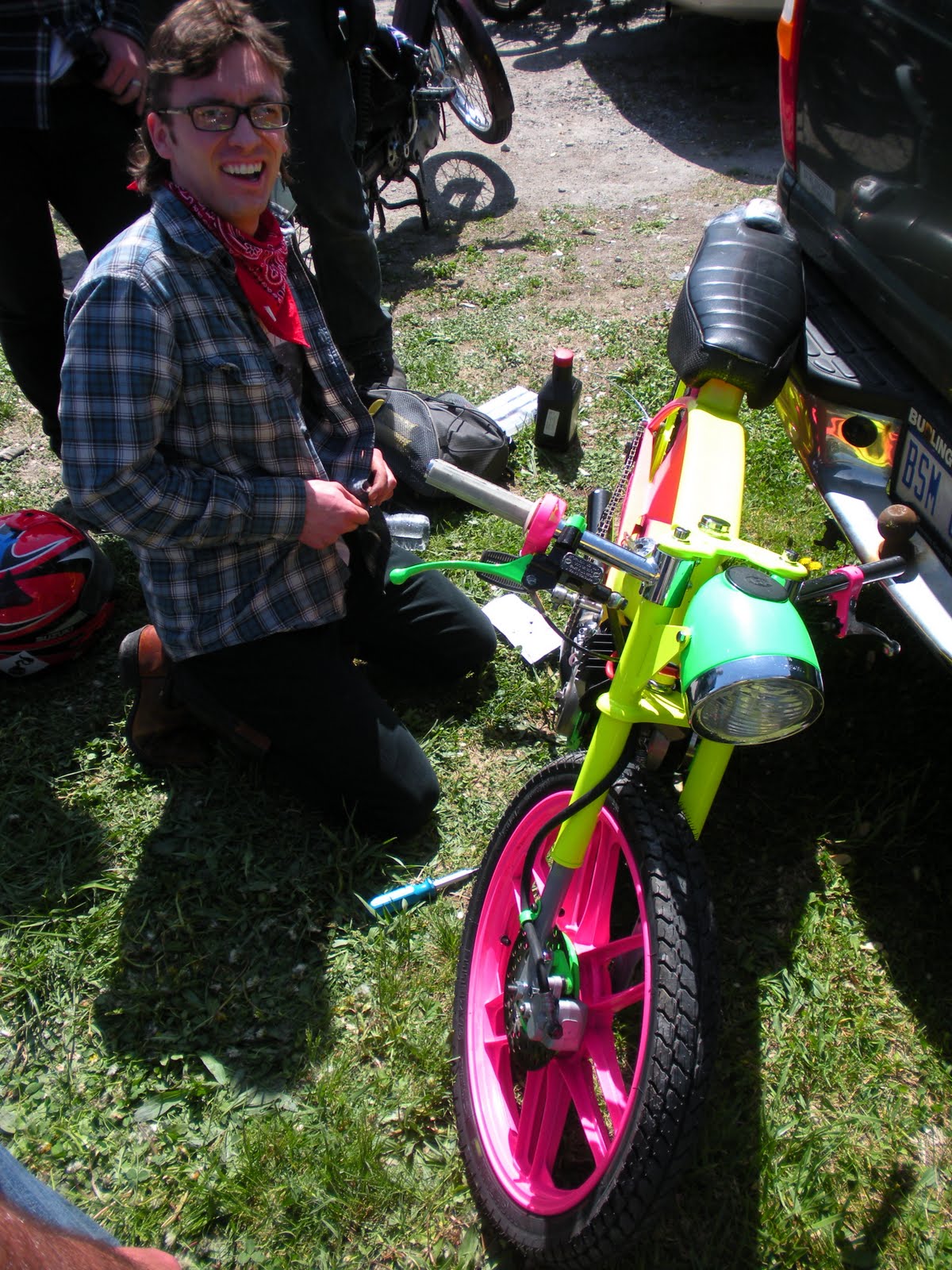
Internette, Julian's amazing neon pink and yellow powder-coated Motobecane/Honda

Hobbits were out in full force led by the Hobbit evangelist Peter, now of the Guns.


Motobecane with matching knee guards:


The infamous reverse triped:


More triped fun:


Shaw-built maxi with exhaust pipe crossbar:


And my favorite bike of the weekend belonging to one of the Hot'n Readys


In Case You Were Wondering...


Sometimes I ask myself if what I am posting is worthy of other peoples attention. Most of the time I could care less. Other times... the question just seems irrelevant.

From the Meno

Men. O Socrates, I used to be told, before I knew you, that you were always doubting yourself and making others doubt; and now you are casting your spells over me, and I am simply getting bewitched and enchanted, and am at my wits' end. And if I may venture to make a jest upon you, you seem to me both in your appearance and in your power over others to be very like the flat torpedo fish, who torpifies those who come near him and touch him, as you have now torpified me, I think. For my soul and my tongue are really torpid, and I do not know how to answer you; and though I have been delivered of an infinite variety of speeches about virtue before now, and to many persons-and very good ones they were, as I thought-at this moment I cannot even say what virtue is. And I think that. you are very wise in not voyaging and going away from home, for if you did in other places as do in Athens, you would be cast into prison as a magician.

Soc. You are a rogue, Meno, and had all but caught me.

Men. What do you mean, Socrates?

Soc. I can tell why you made a simile about me.

Men. Why?

Soc. In order that I might make another simile about you. For I know that all pretty young gentlemen like to have pretty similes made about them-as well they may-but I shall not return the compliment. As to my being a torpedo, if the torpedo is torpid as well as the cause of torpidity in others, then indeed I am a torpedo, but not otherwise; for I perplex others, not because I am clear, but because I am utterly perplexed myself. And now I know not what virtue is, and you seem to be in the same case, although you did once perhaps know before you touched me. However, I have no objection to join with you in the enquiry.

Men. And how will you enquire, Socrates, into that which you do not know? What will you put forth as the subject of enquiry? And if you find what you want, how will you ever know that this is the thing which you did not know?

Soc. I know, Meno, what you mean; but just see what a tiresome dispute you are introducing. You argue that man cannot enquire either about that which he knows, or about that which he does not know; for if he knows, he has no need to enquire; and if not, he cannot; for he does not know the, very subject about which he is to enquire.

Men. Well, Socrates, and is not the argument sound?

Soc. I think not.

Men. Why not?

Soc. I will tell you why: I have heard from certain wise men and women who spoke of things divine that-

Men. What did they say?

Soc. They spoke of a glorious truth, as I conceive.

Men. What was it? and who were they?

Soc. Some of them were priests and priestesses, who had studied how they might be able to give a reason of their profession: there, have been poets also, who spoke of these things by inspiration, like Pindar, and many others who were inspired. And they say-mark, now, and see whether their words are true-they say that the soul of man is immortal, and at one time has an end, which is termed dying, and at another time is born again, but is never destroyed. And the moral is, that a man ought to live always in perfect holiness. "For in the ninth year Persephone sends the souls of those from whom she has received the penalty of ancient crime back again from beneath into the light of the sun above, and these are they who become noble kings and mighty men and great in wisdom and are called saintly heroes in after ages." The soul, then, as being immortal, and having been born again many times, rand having seen all things that exist, whether in this world or in the world below, has knowledge of them all; and it is no wonder that she should be able to call to remembrance all that she ever knew about virtue, and about everything; for as all nature is akin, and the soul has learned all things; there is no difficulty in her eliciting or as men say learning, out of a single recollection -all the rest, if a man is strenuous and does not faint; for all enquiry and all learning is but recollection. And therefore we ought not to listen to this sophistical argument about the impossibility of enquiry: for it will make us idle; and is sweet only to the sluggard; but the other saying will make us active and inquisitive. In that confiding, I will gladly enquire with you into the nature of virtue.

Men. Yes, Socrates; but what do you mean by saying that we do not learn, and that what we call learning is only a process of recollection? Can you teach me how this is?

Soc. I told you, Meno, just now that you were a rogue, and now you ask whether I can teach you, when I am saying that there is no teaching, but only recollection; and thus you imagine that you will involve me in a contradiction.

Replacing the Replaced Crank Seal, Again


I mentioned in an earlier post that I was rebuilding my Honda PA50II engine as it was showing signs of a bad seal: no idle, overheating, and other inconsistencies. While your replacing a seal it's usually a good idea to replace the bearings, especially if your running a kit. Honda cranks are pretty tough and I don't think performance versions are readily available, so I'm sticking with the stock crank. I ordered new bearings and bought a set of seals off a friend who also has a kitted PA50II. When I opened the cases (for which I had to make a special clutch-puller out of a Honda axle nut welded to a pipe with a M14 nut a bolt at the other end), I found the magneto side seal had completely worn through and that the seal spring was in contact with the crank. This was definitely the problem. 

Here is the bad magneto-side seal:

The split cases with existing bearings and seals:
 

I removed the old bearings, cleaned the cases inside and out and installed new bearings by heating the cases in a toaster and placing the crank (with bearings installed in a freezer) and then lightly hammering them together with an added layer of Yamabond.


After I had installed the new bearings and seals and almost reassembled the entire engine I realized that the stator plate has a little lip which requires that the magneto side seal be recessed in the cases about 1/4 inch. I hadn't realized this when I installed the seal, so I tried pressing the seal further into the cases. 

Well, I pushed it too far... Needless to say, I had a much worse case leak on my hands.

This was all in October.  I took a break... and about three weeks ago I cracked the cases again to reposition the seal only to find that the seal had been destroyed by the inexplicable PA50I worm gear on the crank (don't ask me why I have a PA50I crank in PA50II cases because I don't know).

The destroyed seal: 
 Regardless, the seal was done, so not wanting to leave my cases open for too long, I put the old seal that I thought wasn't bad back in. 

Apparently that seal was bad too...

So, I ordered another seal, and fresh cases gaskets from Treats along with a Malossi 21mm intake so I can run my 21mm PHBG carburator (off the Puchavus) as soon as I find it... I cracked the cases again, replaced the seal at the correct depth and reassembled the engine.
Variated cases are beautifully simple:

While I had the cylinder head off I noticed the piston was wearing around the edge, probably only at quite high RPM's because the damage was very light. I took a Dremel and cut a deeper squish band into the head.

Here's the damage, I'll try posting pictures of the modified squish band later:
 
The new engine runs very well, with some minor overheating that I think is a result of poor timing... I'll get to that later. In the meantime the carb is leaking... Ah, mopeds!

My current setup is a 70cc Polini cylinder with stock 12mm carburator and stock exhaust with notched stock variator. If I can get the overheating issues cleared up I expect to see 45mph at The Bourbon Bandit's Whiskey Business.

Next up 21mm PHBG carb and Motion Left exhaust.

On Classicism and the Purpose of Architecture

Classicism and Tradition
The classical is a term used to denote works of architecture of the past which are prized by later generations as the most perfect examples for the guidance of current practice and for the assurance of future success. The classical is the embodiment of the best in a continuous tradition of architecture stretching from the origins of building to our own time. As such, the form that the classical takes is necessarily contingent on the requirements and propriety of both time and place. The classical of one era will not take shape in the same way as that of another, nor will the classical of one place necessarily resemble that of a different place even at the same time. Conventions such as habits, fashion, language and ways of building change over time and in different places, gaining their correctness through general acceptance and tradition. To understand this is to realize that tradition is the way things change, the means by which universal truths are translated to the particular and conventional, or more importantly, the means by which we have access to the universal. Tradition is not an impediment to change, but a proven system through which innovation and adaptation are given the possibility of realization. Within a tradition knowledge, skills and customs are guarded and handed on to succeeding generations, and it is through the tradition that they are necessarily altered.

American Tradition
As citizens of America our tradition is that of the West. This is not to say that the tradition of Greco-Roman-Judeo-Christian architecture is the only one in our country, or the first, but that it is the embodiment of our “life, liberty and the pursuit of happiness.” The need to separate our new republic from the colonialism of England and justify our classical system of government prepared America for the embodiment of its constitution in an architecture of western classicism. Little wonder that the author of the Declaration of Independence should also design the new capitol of Virginia using the classicism of the Roman temple. Fiske Kimball in his American Architecture (1928) asserts that “the classical ideal thus embodied was ultimately to rule in America to a degree unknown in Europe." Indeed, it was to precede it by more than a decade.

The Purpose of Architecture
To the contemporary architect wishing to participate in the tradition of classical architecture the question of what is unchanging in a tradition is of singular importance. In a tradition so full of seemingly different forms it has been difficult to determine what it is that should guide contemporary practice. The embodiment of the political order in the architecture of America is significant in that it points to the most essential truth of the classical tradition: the understanding that the highest good in life is the perfection of our nature, a good held since the Greeks to be accomplished through the moral life led in community. This is the self-evident truth behind all of the greatest political systems of the past and the guiding principle in the formation of our American system of government, and the one still at work in our constitution. What this means for architecture is that our ability to pursue our highest end as individuals is dependent on the freedom insured by our government, and that architecture serves this good as the embodiment of the state. In other words, architecture is the visible part of the more important politics.

Laundering Literature

Bowdlerization – A form of censorship named after Thomas Bowdler (1754-1825), a prison reformer trained as a physician and avid chess player who published an expurgated edition of Shakespeare in 1807. Words, themes and even characters which Bowdler deemed inappropriate were removed entirely, however he claimed proudly not to have added anything! After the relative success of “The Family Shakespeare” Bowdler set about a similar task, this time with Edward Gibbon’s monumental Decline and Fall of the Roman Empire which his sister published posthumously. Though perhaps not as preposterous as an alteration of Shakespeare, the attempt to make Gibbon less “racy” was met with much less success and even well deserved ridicule. To the idea of liberal learning perhaps only outright censorship could be more antithetical than this regurgitated version of primary sources. The desire to sanitize literature is the bright side of the more evil rewriting of history.

Building Expansion Chambers


Two weeks ago I started learning how to form 18 guage steel into the Motion Left RevRun expansion chamber. Hand forming the steel cones with a sand-filled hammer is labour intensive and takes a deep understanding of how the metal stretches as it is bent. Even with a special turned rock maple form it is necessary to constantly make adjustments to account for the gradual stretching of the metal.


An expansion chamber operates on the principle of acoustic reverberation. Partially combusted gases are usually wasted as they are forced out of the cylinder and into the standard exhaust. An expansion chamber takes advantage of this partially combusted gas as it is forced out of the cylinder and bounces it back into the cylinder in what can best be described as an "echo." This principle only works with the two-stroke engine since every stroke is powered as opposed to the four stroke cycle where every other stroke is powered. Through the use of variously composed cones this echo can be tuned to take advantage of a specific cylinder, power range or speed. Since the cones are fixed it means that top performance is achieved only at specific reverberations. This means that an engine running an expansion chamber will have a "power band," or a specific rpm at which there is a sudden increase in power. Through the use of multiple cones the power band can be concentrated at a specific rpm, or spread out over a wider range. Where this power band falls and how broad it is is determined by the geometry of the cone angles. On the other end of the process, un-combusted gases forced back out of the carburator can be retained using a velocity stack.

It is generally acknowledged that while many computer programs and formulas exist explaining it, the principle remains a black art only perfected through experiment, which is exactly what Motion Left is doing. The RevRun is the first expansion chamber from ML and is designed for 64cc and smaller engines, specifically the Polini. 


By the end of the day I had beaten my thumb to a pulp with the sand-filled hammer, my arm ached and I had sliced open my hand, and learned the basics of tack welding light-guage metal.

I have been told that a member of Seattle's Mosquito Fleet recently reported 62mph with a RevRun he had just purchased and ran on his 64cc Polini with stock 15mm Bing carburator. Other reports describe jumps in speed in excess of 10 mph at speeds above 50 mph. Not bad... 

For more information on how expansion chambers work and an amazing animated GIF click here.

Classicism and Neoclassicism

What is the difference between classicism and neoclassicism, between great architecture and abortive attempts to return to it? Why am I interested in figuring out the difference between classicism and neoclassicism? The contrast sheds light on those tenets of traditional architecture which are most ambiguous to me, and which are perhaps, most essential. I am not interested so much in demonstrating the benefits of a classical architecture as I am in understanding how it can be successfully invoked once again. It appears to me from a survey of contemporary traditional buildings that one of the greatest pitfalls for the architect attempting to reestablish a connection with classical architecture is the error of revivalism. It will be my goal to describe how revivalism is in fact directly antithetical to the concept of tradition, and more significantly, how the essential conflict lies in our understanding of how man progresses through history. Perhaps this too is only symptomatic of a deeper contrast; regardless I will determine that as I continue the debate.

Is revivalism really the greatest pitfall for the classical architect today? There are a number of ways of approaching the question of what differentiates the continual awareness of the past, characteristic of classical architecture, from neoclassicism, a term used to describe movements such as revivalism, or eclecticism which seek to make a specific historical period, or period motif, the basis for all modern building and which have successfully been shown to be the progenitors of modernism. That modern architecture’s nature is akin to that of neoclassicism is symptomatic of the difference between classicism and revivalism. Several thoughtful expositions of the kinship between the ideals of neoclassicism and modernism exist, but these are merely similarities in the degree to which there has been a departure from a rational understanding of how we are capable of living.

The beginning of the question lies in the difference between classicism and neoclassicism just as I have phrased it, but it will be helpful to understand how neoclassicism and modernism are similar in order to distinguish the more essential contrast. More basic than the terms classicism and neoclassicism is an understanding of how the advent of historicism, or a shift in the way we have viewed progress has changed the process of imitation, the means by which we participate in tradition. Latent in the theory driving revivalism is the concept that contemporary architecture is in a different category from that of the past. This understanding of “the modern” is derived from the supposition that humanity is progressing toward a state of perfection on earth.

To begin to understand these ideas it will be necessary to understand how both Vitruvius and Alberti regarded history and the history of historicism. I propose to continue this exploration in the coming months.

Firefly Press


Pretty beautiful stuff, and I like his enunciation of the spontaneity of classical typography, although I'm not sure about his "only responsible for my watch" comment.

Yvette's New Artist in Residence

CAUTION! This post is completely inane. ~*~*~*~*~*~*~!!!
 
As I believe I have already mentioned, I am continually blown away by this website. Especially the new page on their artist in residence. I keep asking myself if this is some amazingly peculiar joke, or a bid for the worst website of all time, but I think it's really serious... I imagine Yvette's to be some kind of magnetic spot where really, really strange people congregate and devise even more nauseating website backgrounds while helping unsuspecting bride-to-be's into apricot-coloured gowns and plotting the return of classical art using household pigments like ketchup red and banana yellow.

And I quote from the artist's bio:
"I have often been asked whether I attended school for my art
education......perhaps the College of Visual Arts, Theater and
Dance @ Florida State University in Tallahassee, the capital of
Florida, or maybe the Maryland Institute College of Art in the
vicinity of the capital of the United States ~*
.........the honest truth is that I have not had the benefit of any
formal education in the Visual Arts at a contemporary art
institute, college or school ~*~*~*~*~*~*~*~*~*~*
if the answer was yes, I know I would have gained a great deal
of advantage from such experience ~*~*~*~*~*~*~*~*~*~*~*~*
my entrance into the wonderful world of Fine Arts, particularly
Drawing & Painting Portraits, came about in a rather unusual
manner, it seems ~*~*~*~*~*~*~*~*~*~*~*~*~*~*~*~*~*~*~*~*~*~*
about six years ago I experienced an amazing Triad of
repeating dream patterns !! ~*~*~*~*~*~*~*~*~*~*~*~*~*~*~*~*~*
for three consecutive nights I was enraptured in the spell of
the most illuminating pageantry of beautiful dreams ~*~*~*~*
regal delightful dreams of rainbows and butterflies and
fireflies and lightening flashes and yellow canaries and
swallow song and sea waves and puffy pink flamingos and
soft white clouds passing aimlessly across a cerulean sky and
stars and spinning spiral galaxies and sunsets and sunrises
on worlds that seemed a world away and to and fro on this
nightly magic carpet ride ~*~* these brilliant, mystical dreams
always ended in the same way........the sound of a heart
pulsing in the midst of random patterns of colors swirling all
around me ~*~*~*~*~*~*~*~*~*~*~*~*~*~*~*~*~*~*~*~*~*~*~*~*~*~*
on the morning after the third night of these enigmatic esoteric
journeys, I was sitting comfortably out back in my tile floored
Florida Room with the ceiling fan on a low setting when a
feeling of inspiration began to overwhelm me........something
like an instantaneous desperation hit me out of the proverbial
blue and I experienced a great compassion to do
something.........."do what?", I thought to myself.........this
uncertainty and confusion lasted for what now seems like 5 or
10 minutes.........I wanted to do something...........I strongly
desired to engage in some sort of activity but I had no idea
what said activity could possibly be ?? ~*~*~*~*~*~*~*~*~*~*~*
then, in a flash, it was clear to me..........I saw myself sitting
before an easel ( at that time I didn't even know what an easel
was nor did I know anything about paint or painting ) with a
palette in one hand and artist's brushes in the other slinging
every color imaginable upon a huge canvas !! ~*~*~*~*~*~*~*~*


..........all the tropical fishes in all the tropical seas of the world and
the majestic polar ices with their arctic casts of shining
auroras abound from here to all eternia and beyond in the
lively parade of promenade adorned in natural royal regalia
gifting us with essential elements of earthen delight !! ~*~*~*~*
~*~*~*~*~*~* sharing happiness with others is a temporal and
~*~*~*~* ethereal pleasure, the wellspring of prosperity ~*
~*~*~*~*~*~*~*~*~*~*~*~*~*~*~*~*~*~*~*~*~*~*~*~*~*~*~*~*~*~*~*
/~~*~*~*~*~*~*~*~*~*~*~*~*~*~*~*~*~*~*~*~*~*~*~*~*~*~*~*~*~*~* Unquote...

Maps from Books X

The Finn Family Moomintroll
by Tove Jensen

Moomin Valley showing a plan of Moominhouse.